Top 40 Americans in the ABL: #35 Gabriel Suarez of the Adelaide Bite and 2013 WBC Qualifier Spain

35SuarezMinor league journeyman Gabriel Suarez, whose grandfather was of Spanish descent, was one of the reasons why Spain won the recent 2012 World Baseball Classic Qualifier in Jupiter, Florida to move on to the 2013 WBC in March. Going 6-for-12 with a .667 slugging percentage and .647 on-base percentage during the four-game tournament, Suarez was a pleasant surprise for underdog España.Adelaide_Bite

Selected by the Montreal Expos in the 26th round of the 2004 MLB June Amateur Draft out of Phoenix’s South Mountain Community College, the Denver-born Gabriel Suarez has played in the minor leagues with stints in the independent and international baseball leagues since turning pro. The 28-year-old Adelaide Bite outfielder has played every position but catcher in his career.

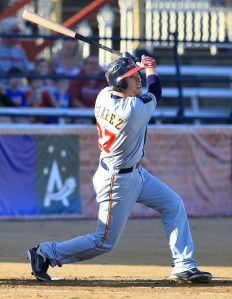
Adelaide Bite's Gabriel Suarez (Ryan Schembri / SMP Images)
28-year-old Gabriel Suarez brings invaluable pro ball experience to Adelaide.(Ryan Schembri/SMP Images)
Debuting in the Montreal Expos/Washington Nationals farm system in 2004-05, Suarez has been affiliated with the Baltimore Orioles (2006), Colorado Rockies (2006), Cincinnati Reds (2006-07), Pittsburgh Pirates (2007-08), San Francisco Giants (2009), Houston Astros (2009), Philadelphia Phillies (2010) and Los Angeles Dodgers (2012). Before being signed by the Dodgers organization in July, Suarez played in the Mexican Leagues for Vaqueros Laguna and Delfines de Ciudad del Carmen as well as in the Independent Freedom League for the Montezuma Federals. Prior to making his way to the Australian Baseball League, the free agent spent time with Dodgers Single-A affiliates Great Lakes and Rancho Cucamonga.

Gabriel Suarez of the Adelaide Bite
The well-traveled utility player has twice found
his way back into the minor leagues by way of independent league baseball. Currently playing
for the 2012-13 Adelaide Bite, Suarez has put together a .235 batting average with one double, four RBI and one stolen base. At the completion of his Aussie baseball expedition in the ABL, Suarez will be focused on the World Baseball Classic. After winning the WBC Qualifier in Florida to advance to the 2013 World Baseball Classic, Spain’s second baseman Gabriel Suarez was already thinking about what was next. “We’re looking forward,” said Suarez. “Dream come true. We came here for this.” Spain overcame the odds with little time to prepare and beat a talented Israel team in the WBC Qualifier Final to earn the right to play against Pool C host Puerto Rico along with powerhouses Venezuela and Dominican Republic in San Juan beginning March 7, 2013.

Spain players celebrate their 9-7 win after 10 innings against Israel in the World Baseball Classic Qualifier Final in Jupiter, Florida on 9/23/12. (AP Photo/Alan Diaz)
Gabriel Suarez and his Spain teammates celebrate their 9-7 win in extra innings against Israel in the World Baseball Classic Qualifier Final in Jupiter, Florida on 9/23/12. (AP Photo/Alan Diaz)

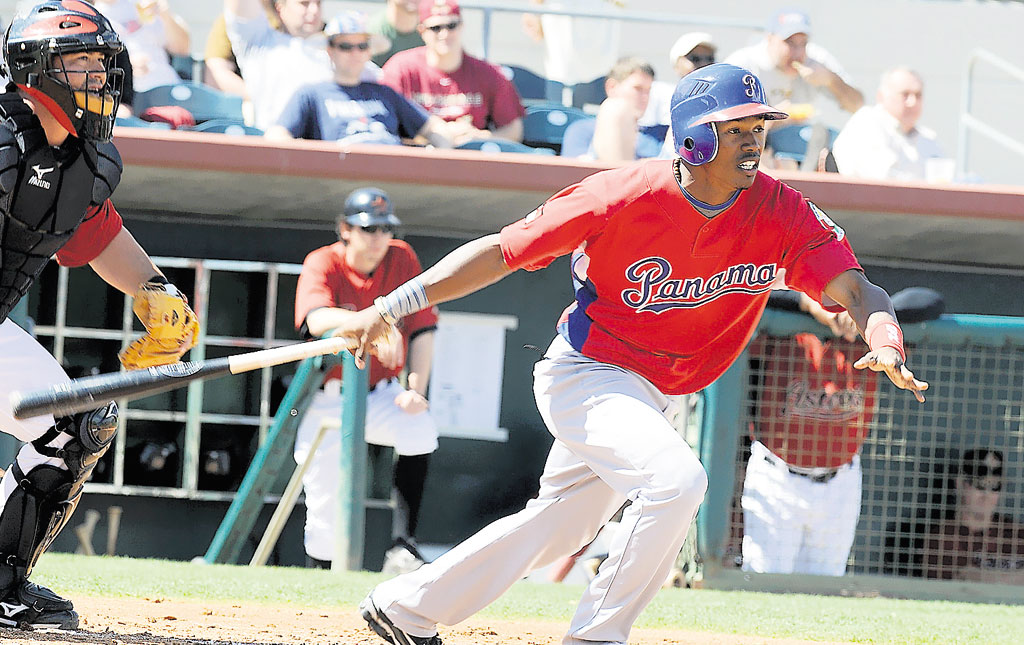
Giants’ Roberto Kelly manages Team Panama with fast track to World Baseball Classic in March 2013

Giants coach Roberto Kelly was very instrumental to
San Francisco’s 2010 and 2012 World Championships.
The San Francisco Giants have never been big in the larceny department. The 1986 team holds the franchise record with 148 stolen bases. After guiding Giants’ baserunners to a 67.5% success rate in swiping bags during his first four seasons, first base coach and baserunning instructor Roberto Kelly turned up the heat to 75% in 2012. Now as manager of host Panama in the World Baseball Classic Qualifier, Kelly hopes to parlay his World Championship magic to lead Panama’s best to a ticket to the WBC competition beginning March 7, 2013.
Roberto Kelly tries to calm down the emotionally-charged Angel Pagan, who led the 2012 Giants in triples and steals.
The 2012 Giants ranked tenth overall in MLB with 118 stolen bases, a vast improvement from last year’s 24th ranking and 85 steals. The team identified baserunning as an area that needed work this past season after their NL-low 2011 run total of 570. Led by outfielders Angel Pagan, Gregor Blanco, Hunter Pence and shortstop Brandon Crawford, instincts and speed made a difference when taking an extra base or advancing from first to third. Reflecting on winning the 2012 World Series and the sudden increase in offense, coach Kelly said: “First of all, we had the guys to do it with. Second, we had to score more runs.” Despite having a more mobile lineup than ever, third baseman Pablo Sandoval and catcher Buster Posey possessed less than optimal speed on base. “Obviously we’re not going to ask those guys to steal 20 bases,” Kelly said. “But they can get bigger leads and let the pitcher know they’re there. Getting a bigger lead’s going to allow you to have a better chance of going from first to third.”
Manager Bruce Bochy is delighted to have such a fine future MLB managerial candidate as Roberto Kelly.
Gregor Blanco saves Matt Cain’s perfect game with his leaping catch on June 13, 2012 and credits his coach Roberto Kelly for his defensive excellence.
San Francisco skipper Bruce Bochy recalled why the Giants recruited the two-time MLB All-Star and successful minor league manager Roberto Kelly in 2008. “The teams he managed had a lot of speed and used it well,” Bochy said. “He has a great way about him, he’s very professional, and he had a successful career in the big leagues. He’ll help the runners to read pitchers, work on their jumps, their secondary leads — all the things that help you take an extra base.” Kelly also has worked with Giants outfielders and helped them post a .989 fielding percentage–third-best in MLB since 2008. Gregor Blanco credits his aggressive outfield approach in making web gem catches throughout the season and his precise bunt stop mere inches fair on the infield dirt in the World Series to coach Kelly. Blanco said, “I was joking with Roberto Kelly when I got to first base. We practiced that. That was a perfect bunt.” When the Hall of Fame asked for the glove that saved Matt Cain’s perfect game, he obliged. Blanco said, “I’m happy to be able to accomplish that,
26-year-old MLB journeyman Luis Durango, who recently signed with the Kansas City Royals, will be Panama’s spark plug against Brazil, Colombia, and Nicaragua in the World Baseball Classic Qualifier.
and I’ll be able to see my glove in Cooperstown. It’s a great deal for me. That comes from hard work and working with the guys, with Angel Pagan, with Roberto Kelly. I have to give credit to them.” Coach Kelly also likes Pagan. “He’s a great talent and has been great for us on both sides of the field,” Kelly said. “He’s been fine for us and in control. He’s very aggressive.” Switch-hitting Luis Durango is Panama manager Roberto Kelly’s answer to Pagan. The speedy outfielder recently signed with the Kansas City Royals after hitting .289 with a .352 OBP and 46 steals for Triple-A Gwinnett Braves in 2012.
Clocked running from home plate to first base on a bunt in 3.4 seconds, Luis Durango replaced injured Michael Bourn on the 2011 Houston Astros roster.
Leadoff hitter Luis Durango was one
of the few bright spots in Panama’s two losses during the 2009 World Baseball Classic Pool D competition in San Juan, Puerto Rico. In game one against host Puerto Rico, Durango singled, walked twice and stole one base. In Panama’s follow-up contest
in which they were eliminated by the Dominican Republic, he went 2-for-3. Hitting .600 in the 2009 World Baseball Classic, Durango was second in the international games in batting average and on-base percentage. Panama’s 48-year-old manager will use Durango’s ability to get on base, steal a bag or two and ultimately score to win the 2012 WBC Qualifier games beginning November 15th at Panama City, Panama’s Rod Carew Stadium.
Roberto Kelly is very gracious with his time and sponsors many youth baseball clinics in Panama.
A positive role model for Panama’s next generation of MLB stars, Roberto Kelly is committed to the growth of baseball in his native homeland and is looking for ways to teach the youth about the game and life’s lessons. After enjoying a solid 14-year Major League playing career and compiling a lifetime .290 batting average with 241 doubles, 124 home runs, 585 RBI and 235 stolen bases over 1,337 games, Kelly is now a two-time World Champion MLB coach and manager of Panama’s national team. An inspiration for many on how hard work and dedication can bring success, Panama looks to Kelly
Roberto Kelly and Panama outfielder Rubén Rivera

to lead the country to greatness by advancing to the 2013 World Baseball Classic. He will not be alone in this special assignment as former MLB outfielder Rubén Rivera (1995-2003) will be there by his side every step of the way. Although his cousin–New York Yankees closer Mariano Rivera–has never participated in the World Baseball Classic, Rubén will be making his third WBC appearance for Panama. Still playing ball and in excellent shape at age 39, Rubén is very much the heart and soul of this Panama squad.
Giants first base coach Roberto Kelly and 2012 World Series MVP Pablo “Panda” Sandoval
With over 3.5 million Panamanians cheering on their national baseball heroes in the World Baseball Classic Qualifier, there’s a good chance that the sense of excitement in Panama City will equal that of the recent enthusiasm at the 2012 World Series Champion Giants celebratory parade in the streets of downtown San Francisco. The common link to key both of these teams is Giant coach and Panama manager Roberto Kelly. With his expertise and his roster of very talented players, Panama is destined to party hard after a win of the
WBC Qualifier Final on November 19th.

Panama’s Rubén Tejada may be small in stature but a big factor in decisive World Baseball Classic


Despite being labeled “The Rookie” for his his small size dating back to his childhood living across the street from Panama’s Omar Torrijos Herrera Stadium, Mets shortstop Rubén Tejada has big league intelligence and baseball embedded in his DNA. The Santiago de Veraguas native wants victory for his country. Host Panama battles neighboring Colombia, Brazil, and Nicaragua in the upcoming World Baseball Classic Qualifier beginning November 15th at Panama City’s renovated Rod Carew Stadium. “The only reason we are here is to win and clinch a spot on the Classic,” Tejada said. “The main thing is move on to the Classic, and God willing, everything will go our way. I come with more experience, so hopefully everything will come out as planned.”

Panama’s secret weapons: Rubén Tejada (on right) and speedster Luis Durango of the Kansas City Royals
The winners from the Panama and Taiwan qualifying pools will join Spain and Canada in the first round World Baseball Classic competition against Australia, China, Cuba, Dominican Republic, Italy, Japan, Korea, Mexico, Kingdom of the Netherlands, Puerto Rico, United States and Venezuela March 7-10, 2013 at Chase Field in Phoenix, Arizona and Salt River Fields at Talking Stick in Scottsdale. Proud to be representing his country again after showcasing his talent in the 2009 World Baseball Classic and having matured into an everyday player for the Mets, 23-year-old Rubén Tejada brings an innate understanding of the game which rivals that of a seasoned veteran or manager twice his age.
Rubén Tejada in 2009 WBC action in Puerto Rico
However, his interpretation of the strike zone sometimes gets lost in translation. In young Rubén’s case, patience at the plate came with a price for the right-handed hitter, who until 2012 had struggled for playing time since making his MLB debut on April 7, 2010. With the strike zone in Panamanian youth leagues being bigger than it is in America, Tejada was trained to swing at pitches that would be called balls in the USA. With this international anomaly, he had
the tendency to swing early at-bat.
Rubén Tejada hit .289 as the 2012 Mets’ leadoff hitter and everyday shortstop with the departure of 2011 National League Batting Champion Jose Reyes.
At age 20, Tejada was the youngest position player on the Mets Opening Day roster since Tim Foli in 1971. Mets hitting coach Dave Hudgens implemented a more disciplined approach to Tejada’s at-bats by making pitchers work. Since then, Rubén now works the count in search of his pitch. “He can hit,” said ex-Mets scout Ismael Cruz–who signed Tejada in 2006. “People don’t give him credit for hitting. He’s not flashy, he’s not making noise, but he’s a guy who can hit .270, .280. I’ll take that any day. And he’ll jack one every so often.”
Rubén Tejada slides head first to score on a hot summer August 2012 night in San Diego.
2011 Mets teammates Jose Reyes and Rubén Tejada faced each other on opposing teams for the first time.
With a career-high 25 doubles, a .289 batting average and a .333 on-base percentage in 112 games played during the 2012 season, Rubén Tejada had a breakout year despite missing nearly six weeks in May and June with a strained groin muscle. Serving as the replacement for 2011 Mets shortstop Jose Reyes, who took the the $10 million bait lured by the 2012 Miami Marlins, Tejada proved to be worth his weight in gold–earning a fraction of Reyes’ salary ($491,000).
Mets’ Rubén Tejada completes a routine double play regardless of Brandon Phillips’ attempt to break it up.
Perhaps what was most impressive about Tejada in 2012 was his defense. The 5-foot-11 Panamanian made spectacular web gem worthy plays and ironically finished the season with six fewer errors than Jose Reyes. The two former teammates remain best of friends and workout buddies. After the WBC Qualifier, Tejada will return to a Garden City, Long Island, New York training facility for his annual post-season pilgrimage with MLB All-Star Reyes. For now the business at hand is in Panama. “I’m very happy to be here, especially to be healthy and ready to do all that is needed to help the team,” said Tejada. “First we will try to win our pass, then we will start thinking about the 2013 Classic.”

“El Caballo” Carlos Lee returns to Panama to corral a victory for his country in World Baseball Classic

A cattle rancher with properties outside Houston and also in his hometown of Aguadulce, Panama, MLB free agent Carlos Lee may not know where he is headed to play for the 2013 season. Yet he does know that home is where the heart is, and right now Panama is his immediate destination for the upcoming World Baseball Classic Qualifier at Rod Carew Stadium in Panama City beginning with host Panama’s opening game against Brazil on November 15th and culminating with the live
MLB Network televised WBC Qualifier Final on November 19th at 5 PM (PST). Home Sweet Home Panama will be Lee’s final outpost when he decides to gracefully retire at the end of his celebrated Major League Baseball career. “When I’m finished, I’m planning to go back home,” Lee said. “I’m from Panama. It’s pretty safe and nice there.”

Former Astros first baseman Carlos Lee chats with San Francisco Giants first base coach Roberto Kelly (also coincidently his manager for Team Panama)
and former Giants outfielder Carlos Beltran during
an August 2011 game at San Francisco’s AT&T Park.
Although 36-year-old Carlos Lee was last seen wearing a Miami Marlins uniform after a 2012 midseason trade, he has always been a fan favorite from early on in his career while playing for Chicago White Sox (1999-2004), Milwaukee Brewers (2005-2006), Texas Rangers (2006) and Houston Astros (2007-2012). White Sox TV announcer Ken “The Hawk” Harrelson–who witnessed firsthand Lee’s 2004 28-game hitting streak, which broke the franchise record and surpassed Rod Carew’s 25-game record for a Panamanian player–knew that the three-time MLB All-Star (2005-2007) and two-time Silver Slugger (2005 & 2007) was a special player and coined him “El Caballo”.
Ex-Houston Astros MLB All-Star Lance Berkman laughs as Panama’s Carlos Lee grabs him during a March 2009 exhibition spring training baseball game in Kissimmee, Florida. (AP Photo/David J. Phillip)

Carlos Lee regularly hosts baseball clinics in Panama.

Despite his place in the White Sox records book, many think of Lee as a lifetime Texan. As the cleanup hitter for Houston, he drove in 100 or more runs in three of his five Astro seasons, averaged 26 homers and hit over .300 three times. Carlos Lee would rather be known for his comparison to Texas ranching icon Nolan Ryan–not for his seven no-hitters, 27 major league seasons, the all-time strikeout record, or his 324 wins–but rather for Ryan’s 2011 Golden Spur Award, which recognizes leadership and exceptional service to the ranching industry.

Minor Leaguers from Don Bosco were given MLB tips.

“El Caballo” lives up to his nickname as the owner of Slugger Ranch in Texas, where he raises prize-winning Brahman, and nine ranches in his native Panama. Lee instantly won credibility with his 2006 Brahman Grand Champion at the largest Brahman show in the world at the Houston Livestock Show and Rodeo. Two years later, he donated $25,000 and over 300 bales of hay to support Texas ranchers whose properties were ravaged by Hurricane Ike.

Little Carlos poses next to dad’s prized Brahman at Ganadera Karla Mary in Aguadulce, Panama.

Father Carlos Lee at Slugger Ranch in Boling, Texas
Growing up around his grandfather’s passion for cattle ranching, Lee is now passing down his love for baseball and cattle breeding to his own son, Carlos Alejandro. Jim Williams of V8 Ranch said of Lee: “Carlos is not only a good baseball player, but he’s also the most progressive breeder in Panama as far as importing top genetics. He probably knows the pedigree and bloodlines of his cattle like a sportscaster would know about statistics.”

Whether it’s the playing of the game of baseball, the breeding of cattle and quarter horses, or the roping of calf, Lee wants to leave behind the family legacy of being among Panama’s best. Baseball Hall of Famer Rod Carew, who was born in 1945 on a train in the city of Gatún–in what was then known as the Panama Canal Zone–currently holds the honorary title of Panama’s best all-time hitter. So it’s only appropriate that the country’s best–including “El Caballo” Carlos Lee–will be playing in the World Baseball Classic Qualifier under Panama’s legendary manager
Roberto Kelly against Brazil, Colombia and Nicaragua at Panama City’s Rod Carew Stadium beginning November 15th. While handicappers are betting on
five days of modified double-elimination competition, insiders will be banking on plenty of horsepower from “El Caballo” Carlos Lee–who plans to lead Panama
from gate-to-wire en route to the WBC Winner’s Circle.

Carlos Lee will lead Panama against Brazil, Nicaragua and Colombia in the WBC Qualifier.

Panama’s Carlos “Chooch” Ruiz ready for 2013 Philadelphia Phillies and World Baseball Classic

Thanks to a clubhouse joke played by pitcher Antonio Alfonseca–who in a 2008 television interview referred to Ruiz as “chucha” (a Colombian slang term for “underarm odor”)–teammates, the media and baseball fans have since referred to the Panamanian MLB All-Star catcher by his beloved nickname “Chooch”. The sweat rebels sacrificed over a century ago which gave Panama independence from Colombia is reminiscent to that of national hero Carlos Ruiz’s in his improbable “I Think I Can” MLB ascent.

“The Panamanian Express” Allan Lewis stole 116 bases for the ’66 Leeburg A’s before playing six seasons in MLB.
Having passed on the 5-foot-8 Ruiz in two prior 1998 tryouts–once as a pitcher and a second time as an infielder–Phillies’ Panamanian scout Allan Lewis (AKA “The Panamanian Express” for being the 1967-73 Athletics’ pinch-running specialist) insisted on new international scouting director Sal Agostinelli fly to Ruiz’s hometown in David, Panama to give the Phillies organization one last look before giving up on this natural-born talent with an outstanding bat. While Agostinelli was having trouble considering Ruiz an infield prospect during the 1998 work out, Lewis suggested they try him out at catcher. After a few drills behind the plate with former Phillies Minor League catcher Agostinelli, it was apparent that Ruiz possessed enough athleticism, physical arm strength and promise to suggest it might just work. In what appeared to be a long shot $8,000 signing bonus in converting a second baseman to a position he had never played before, Philadelphia offered Ruiz a pro contract and an invitation to the Phillies Dominican Baseball Academy to become a catcher.
Phillies scout Sal Agostinelli signed MLB All-Star Catcher Carlos Ruiz in 1999.

When Ruiz shared the news with his schoolteacher mother that he had been offered a $8,000 signing bonus with the opportunity to play in the Dominican Republic to start his professional baseball career in the Phillies organization, Inocenicia Rios was a bit nervous. After all, her 19-year-old son would be dropping out of school and abandoning his college coursework toward a degree in physical education for little money to beat the odds of making it to the Big Leagues at a position he was unfamiliar with.

Carlos Ruiz’s parents (shown above) knew how important it was for their son to pursue his dream of playing MLB and ultimately supported him.
Nearly a decade later when her son caught the final pitch of the 2008 World Series to give the Phillies their second championship in franchise history, Panamanian President Martin Torrijos called Ruiz’s mother to congratulate her for supporting Carlos’ decision to realize his dream. Call it Panamanian pride or unconditional love for her son in what seemingly was a futile trip to the Dominican catching baseballs… In the end, the journey to MLB was definitely worth the 2008 World Series ring and the subsequent Presidential Ceremony honoring the Phillies catcher at President Torrijos’ residence at Palacio de las Garzas. When Ruiz was caught between a rock and a hard place having to decide whether to report early to 2009 Phillies Spring Training to work with the Philadelphia pitching staff or represent his country in the 2009 World Baseball Classic, President Torrijos sealed the deal for Team Panama with a personal phone call to encourage the isthmuth nation’s eighth ranked all-time leader in hits to participate in the international competition.
Panama’s Rubén Rivera, left, jokes around with Carlos Ruiz during a training session before the 2009 World Baseball Classic in San Juan, PR. (AP Photo/Andres Leighton)
Howard, Halladay and Ruiz celebrate
the 20th perfect game in MLB history.
Although Ruiz has been heralded as one of baseball’s best hitters today, his skills behind the plate are top-notch. He has taken the initiative to study as much as he can about hitters by reading countless scouting reports on players. As he began to notice things take place on the field, Ruiz learned about which situations required certain strategies. By seeing the adjustments hitters were making, he adapted by calling pitches to counteract them. His confidence to call pitches and to control the pace of the game garnered him the trust of the Phillies pitching staff. Ruiz’s natural leadership skills and keen understanding of the game has made him perfectly suited to playing catcher. Perhaps the true testament to Ruiz’s mastery came and went twice when he caught Roy Halladay’s perfect game during the 2010 regular season and Doc’s no-hitter encore in the 2010 postseason.
Panama’s Carlos “Calicho” Ruiz & “El Hombre Araña” Rubén Rivera.
Phillies cleanup hitter Carlos Ruiz
It was recently announced that the Phillies picked up the $5 million club option on Ruiz’s contract for the 2012 All-Star catcher to return next season. That’s a good move for the rebuilding organization–considering that in 2012 Ruiz posted an all-time career best .325 batting average, which put him in a tie for seventh-best in the league among players with at least 400 plate appearances. His 32 doubles, 16 home runs, 68 RBI and a .935 OPS in 114 games kept Philadelphia alive in the NL wild card hunt late in the season. Despite a lagging foot injury in August which kept Chooch out of the lineup for some time, Carlos Ruiz hit cleanup for the 2012 Phillies in 32 games and fifth for another 32 games. However, Ruiz absolutely raked in the four hole, batting .365 with a .587 slugging percentage and 1.008 OPS in 138 plate appearances.
If Philadelphia doesn’t acquire a big right-handed slugger during the offseason, the Phillies may very well use Ruiz again in 2013 as their cleanup hitter.
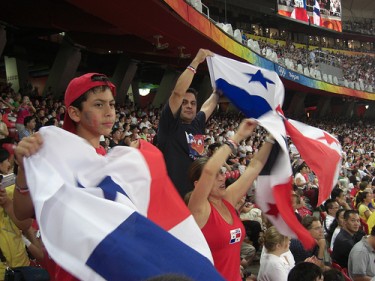
Panamanian flags will be waving during the World Baseball Classic Qualifier on November 15-19
at Panama City’s Rod Carew Stadium. Host Panama, Nicaragua, Colombia and Brazil compete
in a modified double-elimination tournament with the winner qualifying for the 2013 WBC.
The pride of Boquerón–Carlos Ruiz will undoubtedly give host Panama an edge over neighboring Colombia, Brazil, and Nicaragua in the upcoming World Baseball Classic Qualifier on November 15-19 at the newly renovated Rod Carew Stadium in Panama City. If you can’t make it there in person, MLB Network will televise the final Qualifier game live from the Panama City, Panama pool on Monday, November 19th beginning at 5 PM (PST). The WBC Qualifiers, which expanded the competitive field of the tournament from 16 to 28 countries, has already seen Spain and Canada advance to the main tournament.

The winners from the Panama and Taiwan qualifying pools will join Spain and Canada in the first round WBC competition against Australia, China, Cuba, Dominican Republic, Italy, Japan, Korea, Mexico, Kingdom of the Netherlands, Puerto Rico, United States and Venezuela March 7-10 at Chase Field in Phoenix, Arizona and Salt River Fields at Talking Stick in Scottsdale. Second round WBC games will be held March 12-16 at Marlins Park in Miami, while the WBC Semi-Finals and Final take place March 17-19 at San Francisco’s AT&T Park. MLB Network will televise all 39 games of the 2013 World Baseball Classic. iViva el Béisbol!

Carlos Ruiz is mobbed by his Phillies teammates after hitting a walk-off home run in May 2010.

An espresso not sold at Starbucks, Italian slugger Alex Liddi jolts Seattle Mariners with power buzz

Don't be surprised when Cafe Liddi is served at a Starbucks near you.
In what coincidently appears to be a part of an international cultural exchange, the first Italian-born and-raised professional baseball player to beat the odds and successfully make it all the way to Major League Baseball in 2011–Seattle Mariners utility infielder
Alex Liddi–may have inspired the first Seattle-born coffee maker to venture into the Italy’s competitive playing field with the opening of retail locations in Milano, Venezia, Roma and Napoli. If that isn’t enough caffeine to combat jet lag, a double shot of Italian international baseball ambassadors–Alessandro Maestri (the first Italian-born and-raised player to have reached AA ball in MLB) along with Alex Liddi–are headed to Japan. Coming off a successful stint as the 2012 ABL Fan Choice in the Australian Baseball League, Maestri–the former Chicago Cub minor leaguer–has signed a contract to pitch for the Kagawa Olive Guyners, while Alex and the Mariners battle the Oakland A’s on March 28th and 29th in a two-game Japan Opening Series to launch the 2012 MLB season.
A double shot of Italy's finest ballplayers--Alessandro Maestri and Alex Liddi--invade Japan.
Both graduates of the Federazione Italiana Baseball Softball (FIBS)-operated Major League Baseball International European Academy at the Olympic Training Center in Tirrenia, Italy, Maestri and Liddi have mentored a whole new generation of Italian youth who aspire to play baseball internationally. Six Italian-born players have appeared in the major leagues, but all of them immigrated to North America during childhood, according to Riccardo Schiroli, communications manager for the Federazione Italiana Baseball Softball and co-author of Azzuri on the Diamond: Characters and Stories. Liddi, however, was born in Sanremo, Italy, and played amateur baseball there before signing with MLB.
Italy's most eligible bachelor, Alex Liddi is loved by loyal baseball fans worldwide.

Alex Liddi has become so popular worldwide that there is an Alex Liddi Fan Club on Facebook. Why shouldn’t they be excited after the 23-year-old bachelor absolutely made the most of his 2012 Mariners Spring Training campaign by showcasing his defensive versatility at first and third base in addition to cranking out some very impressive offense: .429 BA/.500 OBP/.714 SLG/1.214 OPS. He led the M’s in hits (15) and doubles (7) plus his 10 RBI were only one shy of team-leading Jesus Montero (11). Liddi said, “I hit for power, but RBI–that’s my job! I’m supposed to drive in runs.” Seattle manager Eric Wedge looks to give more opportunities for the powerful 6-foot-4, 230 pound Italian slugger as a utility infielder and a secret weapon off the bench. The Mariner skipper remained optimistic before boarding his flight to Tokyo and commented, “The more versatile he is, the more quickly we might find a spot for him.”
With three home runs, three doubles and six RBI
in just 40 at-bats, Alex Liddi was nothing short
of spectacular in his MLB debut in September 2011
for the U.S. Pacific Northwest's Seattle Mariners.

Having athleticism in his blood helped Liddi early on. His father, Augustine, played baseball and taught Alex the game. His mother, Flavia, played softball at a competitive level and inspired her son to love baseball at age three. In 2004, Liddi played for the Italian National Junior Team in the World Junior Championship. Signed in 2005 by Mariners’ international scout Wayne Norton and Mario Mazzotti, one of the team’s European scouts, Liddi competed in Italy up until the time of signing a professional contract at age 17.
He went on to play for the Italian National Team in the 2006 Intercontinental Cup, the 2007 European Championship and the 2009 World Championship. Alex was also a member of the Italian National Team in the World Baseball Classic (WBC) in 2009, when he hit .375 under the guidance of hitting coach and MLB All-Star great Mike Piazza.

Infielder Alex Liddi will be switching off from his
third base position to first base in the M's line-up.
Having already played on three consecutive MLB All-Star Futures games, Alex Liddi knew in his heart that it was just a matter of time before he would join the game’s elite in Major League Baseball. It really hit home that he was ready for the Big Leagues after successfully squaring off with many MLB pitchers in the WBC. “Playing in the World Baseball Classic in 2009 was really good for my confidence,” said Liddi. “It showed
me that I was good enough to play against some of the best. After that,
I felt like I belonged here.”
Although his 2011 Minor League season for the Triple-A Tacoma Rainiers was stellar with 30 home runs, 104 RBIs, 121 runs scored, 32 doubles and 61 walks, Liddi had his share of strike outs. However, in his second spring in Major League camp, Liddi made some adjustments at the plate with a lower leg kick. After working with M’s hitting coach Chris Chambliss, Liddi’s swing appears to have shortened–which results in him making more contact. Alex Liddi has more raw power and a better eye for walks than his main competitor–Kyle Seager–for the third base back-up job behind utiltyman Chone Figgins, who will seemingly play anywhere to accommodate Liddi’s hot bat in the Mariners’ line-up.

Overall, Liddi could not be happier with his progress at M’s camp. “Things have been really good here,” Liddi said. “I feel like I’ve improved on my contact. That’s what it’s all about. My goal is to be a .300 hitter and drive in some runs.
I don’t really care about home runs.
I care about RBI. I’m still working on it. I’m getting better.” Saying ‘sayonara’ to the Field of Dreams in Arizona and ‘ciao’ to the Land of the Rising Sun in Japan, Liddi has embarked on a remarkable journey of perseverance, dedication and validation in his first full season in MLB. Let’s enjoy the show! Buona fortuna Alex!!

Mineo: legendary historical landmark of Sicily or Italy’s finest catch exported to the Chicago Cubs?

A panoramic view of the archaeological site of Rocchicella di Mineo, ancient Palikè, the location
of the most important sanctuary of Sicily's indigenous Sikel people in the eastern part of the
island with Mount Etna, Europe's largest active volcano, towering over Catania seen far away
The Siculi (Sikeloi; Sicels; Sikels) were the native inhabitants of the eastern regions (including Mineo) of Sicily south of the Italian Peninsula over 10,000 years ago. The island of Sicily takes its name from the indigenous Siculi people. With its strategic location at the center of the Mediterranean, Sicily is rich in its history of conquest and empire. It is a melting pot of cultures with over a dozen ethnic groups whose warriors and merchants walked her shores. Although the other two indigenous societies of the Sicanians and Elymians assimilated easily with the Greeks, the Sicels constituted a highly developed society that the Greeks respected profoundly. Despite conflict and its desire to remain autonomous, it took several centuries for the Sicels to completely assimilate and amalgamate with their Greek neighbors. Except for the Romans, the Sicels were the only predominantly Italic people to settle in Sicily in large numbers as colonists.
Italy leads all European countries in its number of immigrants to America. Beginning in the late 1800’s, poverty and natural disasters drove Italians out–especially in Il Mezzogiorno, the southern and poorest provinces of Italy. As late as 1900, the illiteracy rate in southern Italy was 70 percent. The Italian government was dominated by northerners, and southerners were hurt by high taxes and unfair tariffs on the north’s industrial goods. Southerners suffered from exploitation by people of the same nationality and religion.
Piazza DiMaggio commemorated the legendary son of an Italian immigant, Joe DiMaggio, who lived the American Dream of playing baseball and the tens of thousands of Italian immigrants who came to America through the Taylor St. U.S. port of entry seeking a new life in the heart of Chicago's Little Italy during the early part of the Twentieth Century.

Self-reliant on only themselves for mere survival, southerners had an allegiance to la famiglia (the family) and l’ordine della famiglia (the rules of family behavior and responsibility). Suffering from a scarcity of cultivatable land, soil erosion and deforestation as well as a lack of coal and iron ore needed by industry, life in the South was difficult. Southern Italy was ravaged in the early 20th century when Mount Vesuvius and Mount Etna erupted and buried towns nearby. In 1908 an earthquake and tidal wave that swept through the Strait of Messina between Sicily and the Italian mainland killed more than 100,000 people in the city of Messina alone. For many Italian immigrants, fleeing to the United States was not to be interpreted as a rejection of their homeland. Instead, it defended the Italian way of life because the money sent home helped to preserve the traditional order. Rather than seeking permanent homes, they desired an opportunity to work for a living and aspired to save enough money to return to a better life in the country of their birth. Unable to earn enough to support their families in their native Italy, they were migratory laborers. The majority were young men–aged 18 to 25–who planned to work, save their money and return home. Hoping their absence would not be too long, they left behind their parents, young wives and kids.
Fast forward a century later and native Italian athletes are still clinging to their roots and culture despite being lured by U.S. professional sports to homogenize into the American lifestyle. The first Italian-born baseball player awarded a MLB contract was pitcher Alessandro Maestri. Signed by Chicago Cubs scout Bill Holmberg, Maestri never pitched at Wrigley Field–even though he was a Minor Leaguer with a wicked Major League slider. However, the Cubs struck gold in 2010 when Holmberg signed then 16-year-old Italian catching prospect Alberto Mineo to a contract.
Chicago Cubs Italian catching prospect Alberto Mineo at 2012 Spring Training in Mesa, Arizona
Catcher Alberto Mineo calms his pitcher down and discusses strategy to get the next batter out.
Now ranked 58th behind #1 Cubbie Starling Castro in the Chicago Cubs Top Players Under 25 Organizational List, catcher Alberto Mineo has his eyes set on making it all the way to Wrigley. The defensive standout with excellent catch-and-throw skills said, “The part that I like most about being a catcher is throwing runners out at second.” The 5-foot-11, 170 pounder has strong hands and forearms which assist his receiving skills and defensive instincts. Blessed with outstanding arm strength and a quick ball transfer exchange, Mineo looks comfortable behind the plate. Exuding confidence as a first-rate catcher, opponents will need to exercise caution on the bases.
Left-handed hitting slugger Alberto Mineo
played for Team Italia at the 18 Under Junior World Championship in Thunder Bay, Canada

Holmberg watched Mineo develop into a natural talent from age 10 and knew early on he was special. Alberto was mature enough to accept feedback and listened to Holmberg and Maestri’s sound advice. He commented, “Both of them, they would always say to me ‘Work hard everyday because there is somebody somewhere else that is working hard to get to the Big Leagues’ and I started believing that I could sign with an American team.” Exercising good plate discipline, Mineo is a patient hitter who jumps on a pitcher’s mistake. “I always think as a hitter that I must wait for my pitch until I get two strikes,” Alberto explained. The left-handed hitting Mineo can demolish the ball with his technically sound swing, and once on base he can demonstrate great speed for a catcher.
Cubs prospect Alberto Mineo has speed on the bases and is very quick with his glove defensively.

After being signed by Bill Holmberg–who also is the pitching coach for the Italian National team and operates the Major League Baseball International European Academy at the Olympic Training Center in Tirrenia, Italy–Ronchi dei Legionari New Black Panthers catcher Alberto Mineo began his professional career in the month-long MLB Australian Academy Summer League, where he became friends with Los Angeles Angeles of Anaheim promising pitching prospect
Alex DaSilva–who later moved up the competitive ladder to play for the Australian Baseball League (ABL)
2012 Runner-Up Melbourne Aces. Mineo played well in Australia (.270 batting average, 1 HR) as did his Italian mentor Alex Maestri, who was so popular that he won the 2012 ABL Fan Choice Award.
Catcher Alberto Mineo has all the tools to follow fellow MLB International European Academy graduate Alex Liddi of the Seattle Mariners and become the second Italian-born player in the Big Leagues.

The ABL’s first Italian pitcher/catcher combo with Maestri and Mineo could become reality if Alberto has his way. Mineo commented, “I had a nice experience in Australia, where I met a lot of great players that I still remain in contact with via facebook. I would really like to play with Alex in the ABL.” The dynamic duo could possibly make their debut in the near future as members of the Italian National team under the guidance and direction of pitching coach Bill Holmberg and former Major League Baseball All-Star hitting coach Mike Piazza. Mineo has played as a member of several Italian National teams at various levels– including the 18 Under Junior World Championship in Thunder Bay, Canada. Italian National team catcher Francisco Cervelli of the New York Yankees now has Mineo as back-up.
Mineo said, “I don’t feel the pressure to be the next Italian to make it in MLB. I just want to have fun and enjoy this amazing experience that I’m living right now. But it would be really nice to play with Alex Liddi on the Italian National team…”
Lady Liberty of a Cubbie kind stands tall and proud in the city of Chicago.

Alberto had an exceptional Cubs 2011 Arizona Instructional League four-game campaign with a
.500 batting average, .556 on-base percentage and .500 slugging percentage. “The Cubs Instructional League was an awesome experience. I really like
to practice with Casey Kopitzke, the catching coordinator. I think he’s really good,” Mineo said.
“So far Cubs Spring Training is going very well. I like to work hard on the field and in the gym. It’s the best place you can go if you love this sport. A couple days ago Kerry Wood, Ryan Dempster and Rodrigo Lopez came to the complex to talk to us about the right way to get to the Big Leagues, but my favorite Cubs player is still Marlon Byrd. Inspired to play baseball at age five by his father and become a catcher three years later, Alberto followed American baseball religiously. “My favorite player has always been Derek Jeter. Now it is Joe Mauer. I really like how he plays, and I also think that he’s a very professional guy,” Mineo said.
Wrigley Field, National Historic Landmark and home of the Chicago Cubs since 1916, is the second oldest ballpark in the Major Leagues and the oldest standing National League ballpark.
Although there had been a long-time association of Italians being die-hard Cubbie fans,
the connection got even stronger when the late and great Hall of Fame Cubs broadcaster Harry Caray–whose real Italian last name was Carabina–signed on to the super station WGN Network in 1982. Although he passed on to baseball heaven in 1998, his legacy is still alive and well today as the legendary Caray’s Italian Steakhouse remains a Chicago restaurant icon. Now with Alberto Mineo in the Cubs organization, Italians in Chicago and beyond should rejoice and be thankful for their ancestors’ sacrifices years ago for the opportunities bestowed upon us in 2012. In the case of the young catching prospect Mineo–not only does he possess the natural skills necessary to become a professional ballplayer–
but he has the unconditional love and support of a dedicated team of international coaches, players, fans and family to be a true Italian baseball ambassador worldwide. Forza Italia!
Italian Cubbie fans of all shapes and sizes await Alberto Mineo's imminent arrival at Wrigley Field.

Grosseto set to experience MLB Italian Renaissance

Italian landmark, the Grosseto Cathedral
Tuscany is regarded as the true birthplace of the Italian Renaissance and home to many influential legends in the history of arts and science–including Petrarch, Dante, Botticelli, Michelangelo, Niccolo Machiavelli, Leonardo da Vinci, Galileo Galilei, Amerigo Vespucci, Luca Pacioli and Puccini. The province of Grosseto lies in southern Tuscany and possesses a rich artistic heritage as well as a small and fascinating center of medieval and Renaissance material and archeological sites that preserve Roman and Etruscan treasures.

Baseball in Italy got its first break in the late 19th century when two American naval ships, the USS Lancaster and the USS Guinnebaug, arrived in the Tuscan port of Livorno. The American servicemen held their first baseball game on January 23, 1884 at the Campo d’Osservazione AKA Observation Field. Enthusiastic crowds cheered on the players, and the games garnered enough interest in the media to include coverage by Livorno’s newspaper, La Gazzetta Livornese. With an eager international following in Italy, early baseball pioneer Albert Goodwill Spalding served as a ‘Goodwill’ ambassador of the sport and held tournaments in Florence, Naples, and Rome in 1889. In an effort to unite forces with the allied Italian Army during World War I, the American Army taught Italian soldiers the sport and held baseball games between the two armies.

Any inter-war following was soon decimated upon the rise of Benito Mussolini’s fascist regime, which banned baseball for its American influence. Baseball experienced an Italian Renaissance post-World War II under the leadership of Ottino and Graziani, when the Lega Italiana Softball and the Lega Italiana Baseball leagues were created. The first professional baseball game between two Italian teams was held on June 27, 1948 in front of 2000 fans at Giurati stadium in Milan. These two leagues would eventually evolve into what is known today as the Federazione Italiana Baseball Softball (FIBS), the governing body of baseball in Italy.

The Italian Baseball League (IBL) was founded in 1948 and is comprised of teams from Bologna, Parma, Nettuno, Rimini, Godo, Novara and Grosseto as well as the culturally Italian yet independent country San Marino. These eight teams compete in a 42-game season. Each team is allowed to have up to four non-Italian citizens, and each team must have at least six Italian citizen baseball players on the field at any given time. Former American players have found a second home in the IBL, including Jay Palma–the 1980 sixth-round draft pick of the New York Mets and current coach for the Novara United team.
Pitcher Mike Hartley believes Italy will rally round a winning team as manager of Grosseto.
Perhaps the most interesting catch for the Italian Baseball League is the recently signed 50-year-old Grosseto manager Mike Hartley. The former San Diego Grossmont College ace and Major League pitcher was in his late twenties when he made his MLB debut with the Los Angeles Dodgers on September 10, 1989 and went on to play for the Phillies, Twins, Red Sox and Orioles. In his six Major League seasons, he made 202 appearances and complied a 19-13 record with a 3.70 ERA. Hartley also pitched successfully internationally in Japan for the Chiba Lotte Marines in 1994 and for Nettuno (Serie A1) in Italy in 1998. His coaching skills were just as impressive as he led the German club Heidenheim Heidekoepfe to a national championship in 2009 and the European Champions Cup Finals in 2010. In addition, Hartley coached the Croatian national team back to the 2011 European Championship (A Pool). The new Grosseto manager commented, “At higher levels, I coach to win and I hate to lose. At lower levels, the focus is on development. In short, work hard, believe in yourself and respect the game of baseball.”
Grosseto will benefit with the addition of former MLB pitcher Mike Smith on the mound and as pitching coach.

Michael Anthony Smith was signed by the Toronto Blue Jays in the 5th round of the 2000 amateur draft at the end of his college career at the University of Richmond. He pitched in 14 games for the Blue Jays in 2002 including six starts. The Minnesota Twins acquired Smith from the Philadelphia Phillies during the 2005-2006 offseason, but he was not called up to the Major Leagues until August 2, 2006. Smith played for the 2009 Brother Elephants team in Taiwan’s Chinese Professional Baseball League (CPBL).
He led the 2010 Brockton Rox of the Can-Am League in wins (12) and ERA (2.87) in 125.1 innings. He was also named to the 2010 Cam-Am All-Star Team, along with Rox teammate and newly signed Grosseto catcher Chris Grossman. Smith went 8-5 with a 3.99 ERA in 94.2 innings during his 2011 Brockton Rox pitching campaign. The 34-year-old MLB veteran will prove to be a valuable asset for the Tuscan squad both as regular starting pitcher as well as mentor and pitching coach for the talented roster of Grosseto hurlers.
Having played for the St. Louis Cardinals organization, Grosseto catcher Chris Grossman is a huge boost to any pitcher's confidence and mental stamina.
Standing at 6-foot-5 and weighing 235 pounds, Grosseto catcher Chris Grossman will intimidate any hitter approaching the batter’s box with his mere physical presence. Having played for the last three-plus seasons for the Brockton Rox, the 31-year-old former Cal Berkeley star is a pitcher’s best friend for having a brilliant mind and an innate sense for knowing how to call a game behind the dish. Former Brockton pitcher and pitching coach (and new Grosetto pitcher and pitching coach) Mike Smith said, “It definitely makes things easier having him catch you. He knows the hitters that have been in the league. He knows how to pitch them and get them out. He is pretty smart about setting up hitters. From a pitching standpoint, you don’t have to worry about what pitch you have to throw. He knows how to set them up, and that is one less thing that you have to worry about. Chris also has a great arm. You know if you can’t hold the guy on, he is able to throw him out. He is always willing to go out there no matter how he feels. He wants to play every day.” The durable catcher hit .296 in 2009 and .313 in 2010 with a career-high 57 RBI, which earned him spot on the Can-Am League All-Star team. A reliable contact hitter who can choose his spots to hit for power,
Chris Grossman
Grossman can be a manager’s secret weapon strategically with men on base for his excellent hit-and-run potential. Having hit over .300 in the first half of the 2011 season, Chris led in the team in walks (36) and stole 17 bases in 93 games. Former MLB player and current Brockton Rox manager Bill Buckner said, “I have been happy with the way that Chris has played. He is a smart player and base runner.” Having tasted the life of a pro Minor League player while a member of the St. Louis Cardinals organization, Grossman would like to get another opportunity to break into the Big Leagues. He echoed, “I am still hoping to get the chance. Meanwhile, I am enjoying what I am doing and being around guys that enjoy playing the game. It is a lot of fun.”
Switch-hitting shortstop Jay Pecci adds spark to a Grosseto team charged with MLB experience.

35-year-old switch-hitting shortstop Jay Pecci has wanted to play in Italy for nearly a decade when he tried out in January of 2005 for the Italian national team that played in the inaugural World Baseball Classic. Although he had hit a home run and a single
in his final scrimmage game, Pecci was cut from the Italian team before the international competition.
Pecci recalled, “It was real close. I felt like I was on
the bubble.” The versatile athlete has always had a knack for high drama going back to college when
Pecci walked on to the Stanford baseball team and impressed enough to become a everyday starter.
A 1998 All-Conference player, Pecci led Stanford to
the 1995 and 1997 College World Series and boasted one of the all-time best College World Series batting averages after going 10-for-17 (.588). At Stanford
he played with MLB success stories Jody Gerut,
Joe Borchard, Chad Hutchinson and eventual Gary SouthShore RailCats teammate Tony Cogan.
Gary SouthShore RailCats All-time leader in hits and at bats, Jay Pecci was the 2008 Northern League
All-Star Game MVP and ranks in the top five in nearly every offensive category in Northern League history.
Originally selected by the Oakland Athletics in the 11th round of the 1998 Major League Entry Draft out of Stanford, Pecci played four seasons in the Oakland A’s system–including a stint at Double-A Midland in 2001. The Novato, California native was claimed the following season by the Seattle Mariners in the Minor League phase of the Rule 5 Draft. He advanced all the way to Triple-A Tacoma before the end of the 2003 season. Pecci finished 2003 as a San Francisco Giants farmhand and spent the entire 2004 season with the Double-A Norwich Navigators in the Eastern League.
Grosseto shortstop Jay Pecci demostrates his acrobatics and athleticism everyday on the field.

Pecci came close to early retirement in 2004 when he fractured his skull and broke his jaw colliding with a Norwich teammate while chasing a flyball in Trenton, New Jersey. Having his jaw wired shut for a month, Pecci was determined in making a comeback. He remarked, “I thought at that point, I wouldn’t let that be my last game in baseball.” In his 15-year pro career, nothing came close to his personal best 2008 campaign with the Indy League Gary SouthSide RailCats. Pecci set the RailCats single-season hits record (115) that season and hit a career-best .317 batting average and .474 slugging percentage along with 26 doubles and nine home runs. He homered in the Northern League All-Star Game in 2008 and earned Most Valuable Player honors after hitting the game-winning home run in the ninth inning of the decisive Game Four of the Northern League Semifinals. Following the 2008 season, Pecci earned his first Post-Season All-Star commendation from the league as the circuit’s top shortstop. An agile and seasoned veteran ballplayer with well over 1000 games of experience, Jay Pecci will give Grosseto a competitive edge in the IBL.
A proven expert in teaching the fundamentals of pitching, hitting, fielding, base running, and game strategy, Grosseto hitting coach Jefferson Infante draws from his experience as a minor leaguer and assistant scout for the Kansas City Royals as well as collegiate coach.
Grosseto hitting coach Jefferson Infante played baseball at Dewitt Clinton High School in the Bronx, where he earned All-City honors and played the all-star senior game at Yankee Stadium. After high school, Jeff played in the Dominican Republic in a recruiting league against professional teams before accepting an athletic scholarship to play at Louisberg College and leading his squad to the National Junior College Athletic Association World Series. MLB scouts took notice of Infante while playing for Ramapo College, where he was named to the All-Conference team and earned All-American Honors. Jeff was drafted as a catcher by the Kansas City Royals in 2004. He went on to play for three years in the Royals farm system for Idaho Falls, and later signed an Indy League contract with the St. Joseph’s Black Snakes in Missouri. Although Jeff’s professional baseball playing career would come to an abrupt ending when he sustained a shoulder injury, he remained in the game as an invaluable coach to collegiate players. As the assistant baseball coach at Baruch College in Manhattan, Infante’s ability to convey information to players and make the game simpler has paid off as Baruch has made three championship appearances and won the 2009 championship title.
Grosseto hitting coach Jeff Infante is the nephew of New York Yankees bench coach Tony Pena (shown here standing to the right of Yankees manager Joe Girardi in the Yankee dugout).
With over 10 years of baseball instructional experience, Infante has been sought after to serve as personal training coach for some of New York’s finest. While offering private baseball instruction for the Cooperstown Athletics Sports Performance Training Facility in Manhattan, five of Jeff’s private alums have gone onto playing professional baseball within the last few years. Coupled with the injection of manager Mike Hartley and pitching coach Mike Smith, Infante and the new blood on Grosseto’s coaching staff now have the ability to positively impact the team’s bright future ahead. Finishing 13 games behind 2011 IBL Champion San Marino last season, the newly revamped and much improved Grosseto squad will be a top contender in Europe as a result of the 2012 MLB Italian Renaissance in Tuscany.

Italian coaching, cuisine, and culture make Italy world-class for MLB hopefuls and European scouts

Baseball in Italy received a Major League surprise last month when an unannounced MLB manager graced the 436 registered attendees with his presence at the Italian Coaches Convention Dinner at Castelnuovo de Garda (Verona). Tampa Bay manager Joe Maddon, a first-generation Italian-American whose father was born in Italy, was overjoyed by the warm reception received at the gala dinner which pays tribute to the coaches that make a difference in the internationalization of baseball in Italy. Madden exclaimed, “I feel at home here, because in the small city in Pennsylvania where I live there is a big Italian community.”

Tampa Bay Rays skipper Joe Maddon embraces his Italian roots.

His grandparents original surname was Madonnini, but after emigrating from the Region of Abruzzo to America
their last name was shortened. Maddon continued, “It is always a pleasure for me to visit Italy. I am proud of my heritage.” The Rays were very well represented in Italy as Maddon brought along members of his coaching staff to lead instructional clinics for the delegation of Europe’s best coaches.

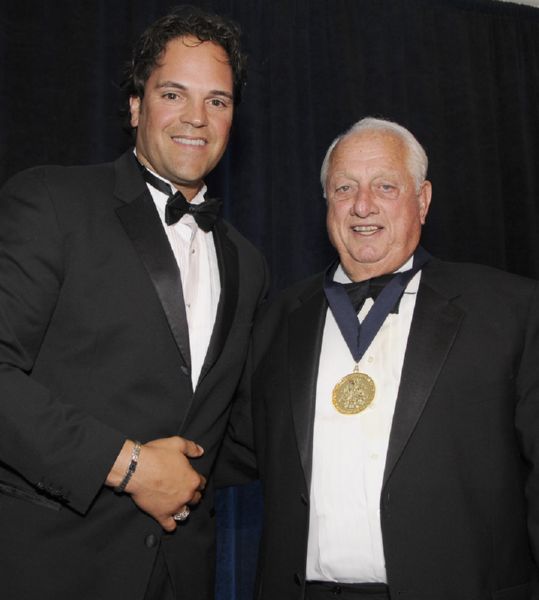
Italian National team coach Mike Piazza (shown here as coach of Team U.S.A.) and Seattle Mariners Alex Liddi (shown here playing for Team World) in the 2011 All-Star Futures Game
Alex Liddi became Italy’s first successful export to MLB and the Seattle Mariners on September 7, 2011.

Riccardo Fraccari, president of the Federation of Italian Baseball and Softball (FIBS), spoke of Alex Liddi becoming the first Italian-born and developed player to play Major League Baseball and its great significance to baseball in Italy. He said, “Alex’s story is really the tip of the iceberg, and we really need to take into account the daily work of the coaches in Italy who are the base of the movement.” Liddi was signed by the Seattle Mariners after being selected to attend the inaugural MLB International European Academy in 2005 and in September 2011 became the first graduate of the MLB International European Academy to play in the Major Leagues.

Italian National team coach Bill Holmberg encourages New York Yankee catcher Francisco Cervelli sitting next to Alex Liddi during the World Baseball Classic.
Like a fine Italian wine, MLB / FIBS Italian Academy Director and Field Coordinator Bill Holmberg has been getting better with age by improving the quality of Italian baseball and coaching Europe’s finest players since landing in Italy in 1989.

Bill Holmberg is one such coach that FIBS President Fraccari was referring to in his compelling speech. Holmberg has been living under the radar since 1989, when he came to Italy to serve as manager and technical director of the Godo baseball club for 12 years. He later became the pitching coach for San Marino as well as the Italian Junior and Senior National teams. Coach Holmberg was named Director and Field Coordinator of the MLB Italian Academy nearly a decade ago and has been instrumental in signing the best homegrown talent as a former international scout for the Chicago Cubs. Everyday he tirelessly trains the cream of the crop at an elite sports academy in the quaint beach community of Tirrenia near the Italian cultural iconic city of Pisa. Alessandro Maestri, the former Chicago Cub minor leaguer and recent Brisbane Bandit / 2012 Australian Baseball League (ABL) Fan Favorite Award recipient, was signed by Holmerg in 2006, when he became the first Italian-born pitcher ever signed by a Major League Baseball team.

In 2006 Chicago Cub European Scout Bill Holmberg signed Cesena’s Alessandro Maestri,
the first Italian-born pitcher signed to a MLB contract. (Scott Powick / SMP Images / ABL)
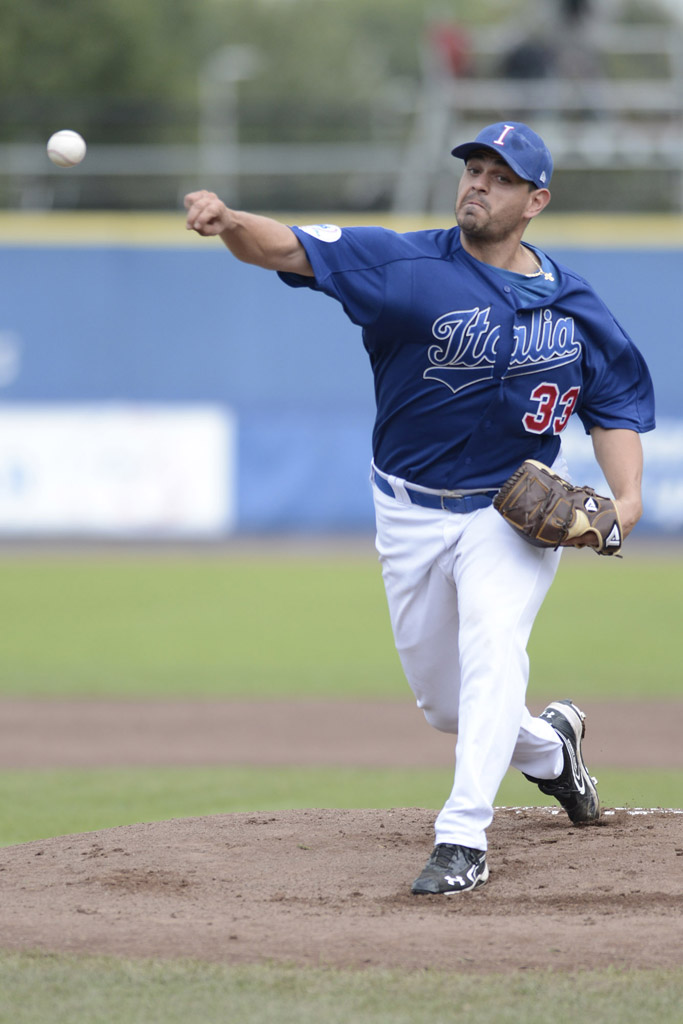
Italian National team pitcher Alessandro Maestri showed the world that he could compete against baseball’s elite in the World Baseball Classic.

Chicago Cub scout Holmberg knew early on that Alessandro was something special when he saw the young Italian play baseball for the first time. Holmberg said, “Alex can do whatever he wants to. He’s got the temperament and composure. He’s hit 95 mph, and his slider is at 86 or 87. He competes as hard as anyone out there.” Maestri still to this day works under the guidance and direction of Coach Holmberg. The Cesena, Italy
native made World Baseball Classic headlines in 2006 when his first offering to the Dominican Republic’s Moises Alou was rocketed out of the park for a home run. Despite the rocky start, he would not allow another earned run in his 4.2 combined innings in both the 2006 and 2009 World Baseball Classics.

Alessandro Maestri as a Cub minor leaguer

Maestri demonstrated great promise in the Midwest and Florida State leagues as a two-time All-Star. As as starter and relief pitcher in the Chicago Cubs minor league system for five seasons, he racked up a 24-17 record with a 3.75 ERA and 19 saves. The right hand throwing pitcher put away hitters with his evasive slider–which was once voted as the best slider thrown by anyone in the entire franchise. Maestri made his preseason MLB debut against the Oakland A’s during Cubs Spring Training in Phoenix on April 1, 2009 when Cub manager Lou Pinella summoned him out of the bullpen. Maestri struck out Orlando Cabrera and then he sized up against slugger Jason Giambi–who was lucky to squeak out a single through the hole. MLB All-Star

Closer Alessandro Maestri was not afraid to show his winning Italian spirit by striking out Jayson Nix to beat Team U.S.A. for the first time in 21 years on November 9, 2007 during the 2007 Baseball World Cup.

Matt Holliday was caught looking at a third strike slider for the second out, and Eric Chavez went down swinging at his Italian slider in the dirt to end Maestri’s almost perfect outing. Nearly three years later, Alessandro is still as dominant as ever as witnessed by his numbers in the most recent 2011-12 ABL season. As the workhorse and ace of the Brisbane Bandit pitching staff, Maestri led his team in wins (4) and proved to be one of the best pitchers in the league. He finished third in the ABL in innings pitched (63.2) and in strikeouts (53), fourth in the ABL in WHIP (1.16) and sixth in the ABL in ERA (3.25). In Round Eight of the regular season, he earned the Pitcher of the Week award after pitching a stellar complete game two-hitter against the Canberra Cavalry. Based on his most recent form, Maestri is worthy of a second look by international scouts to make his long-awaited MLB debut. He will always be a competitor who lives on the edge to bail his team out of pressure situations.

MLB / FIBS Academy Director
Bill Holmberg is committed to producing Italy’s finest athletes.

Of the frequent MLB-sponsored instructional clinics throughout Europe, none has had the impact of MLB / FIBS Academy host Coach Holmberg’s annual three and a half week summer invitational Major League Baseball International European Academy at the Olympic Training Center in Tirrenia. Designed to provide promising junior teenage players with both the environment and the instruction to reach their full potential, the European Academy brings together around 50 or more of the brightest young playing talent in Europe and Africa with the best in Major League coaching and instruction. The Academy seeks to provide a path for elite players from this region to improve their skills in preparation for the rigors of professional and international baseball. In addition to helping these bright young stars develop their skills, the Academy enables MLB Clubs to scout the best future talent. Holmberg explained, “It’s a pretty good place to see all the best players in Europe at one time. We’ve had between 18 and 20 scouts that have watched the games this past year.”
The Tirrenia baseball camp, which began in 2005, has much to do with MLB’s accelerated rate of signing the European elite to professional contracts based on the fact that the numbers have more than tripled from 2005 (2.33 average) to 2011 (9.0 average). So far 49 Academy graduates from ten countries (45 players from Europe and 4 players from Africa) have signed professional contracts with 19 different Major League Baseball franchises. Holmberg commented, “We’re not the Dominican Republic yet, but I think we might be sneaking up on Australia.”

Food for thought: Pitcher Alex Maestri–Italy’s first export to MLB imported by ABL’s Brisbane Bandits

When asked about preparations for his Italian squad in the 2009 World Baseball Classic, the best hitting catcher in Major League Baseball (MLB) history and Team Italy hitting coach Mike Piazza replied, “We’ll have the best food.” All joking aside, Pizza commented: “You’ve got talent in Italy, think of Alex Maestri and Alex Liddi… To help talented kids you need to get them to play more games. Look at me, I didn’t really improve until I was given the possibility to play every day.”

Alessandro Maestri was the first Italian-born pitcher signed by Major League Baseball in 2006.

The 26-year-old Alex Maestri made MLB history as the first Italian born pitcher to be signed by a major league club–the Chicago Cubs–in 2006. Three years later another historical milestone in baseball would take place when the Italian prospect would finally compete on the Major League level. Thinking that it was yet another day on the bench or perhaps a really good April Fools prank, April 1, 2009 would go down as a very Big League day for Alessandro Maestri. Upon reporting to a Cubs Spring Training game in Phoenix against the Oakland Athletics, Maestri was informed that he would making his first preseason Major League pitching debut, which many would consider to have been “textbook”
and as good as it could ever be.

The setting was perfect under a pleasant 71 degree warm Arizona sun for Maestri to take over for Cubs starter Carlos Zambrano and Luis Vizcaino in the fifth inning. Little did Maestri know that he would come face-to-face with some of Major League Baseball’s most feared hitters. His first strike out victim was Orlando Cabrera, who was caught looking at a fastball on the outside corner. Next up with slugger Jason Giambi, who managed to squeak out a single through the hole. Following was Matt Holliday, nicknamed “Big Daddy” for his towering six-foot-four stature and his muscular physique. Maestri dug down deep and mesmerized the intimidating Major League All-Star with a called third strike slider for out number two. The selective Eric Chavez worked the count full before swinging and faltering to Maestri’s wicked slider in the dirt for his third strikeout. Upon returning to the dugout, legendary Cubs skipper Lou Pinella congratulated the young Italian hurler.

As as starter and relief pitcher in the Chicago Cubs minor league system for five seasons, Maestri racked up a 24-17 record with a 3.75 ERA and 19 saves. A two-time minor league All-Star, the right hand throwing pitcher put away hitters with his evasive slider–which was once voted as the best slider thrown by anyone in the entire organization. Representing his native Italy in the 2006 and 2009 World Baseball Classic (WBC), Maestri dominated hitters. In the 2009 WBC, Maestri held opponents scoreless in his two plus innings–during which he got Miguel Cabrera to ground out on a fielder’s choice and Magglio Ordonez to strike out.

Since joining the Brisbane Bandits in the Australian Baseball League (ABL) this month, Maestri has been brilliant. In his first two ABL victories against the Canberra Calvary and the Sydney Blue Sox, he threw over 10 innings of scoreless ball and struck out 11. Add to that total another 8 K’s he put down on his most recent indecision versus the Melbourne Aces on November 18th, and Maestri has tallied 19 strike outs in just over 17 innings pitched. With the ABL’s fifth lowest ERA (1.56), the five-foot-eleven Italian has dished out almost nothing but zeros across the box scores. Look for Maestri to battle teammate Yohei Yanagawa–Japan’s 2011 Nippon Professional Baseball League Champion Fukuoka Southbank Hawks reliever, who has struck out 20 as a Bandits starter in over 16 innings–and Canberra Cavalry’s Michael McGuire–a six-foot-seven, 240 pound 2008 First-Year Player Draftee by the Cleveland Indians from the University of Delaware and currently a Philadelphia Phillies minor league starting pitcher, who now leads the ABL with 21 strike outs in 13 plus innings of work–to battle it out until the end for the title of 2011-12 ABL Strike Out King.

When the ABL season concludes in late January, Alex Maestri is scheduled to head to O’Flallon, Missouri to pitch for the 2010 Frontier League Champion River City Rascals after being acquired in a trade last month with the Lincoln Saltdogs–2009 American Association of Independent Professional Baseball Champions. Heralded as the premier Italian born baseball champion of Major League Baseball, Maestri has fast become a favorite in the Australian Baseball League’s appetite for imports as a leader of the Brisbane Bandits.