While America’s exports to Australia amounts to over $27.5 billion, baseball is a priceless Aussie favorite. No matter how many machines, engines, pumps, vehicles, aircraft, spacecraft, gems, precious metals, coins, pharmaceuticals, plastics, rubber and chemical goods make their way Down Under, these were some of the Top 40 American imports (#11-20) in the thriving
2012-13 Australian Baseball League.
Thanks to all the @sydneybluesox fans for a great season and making al the imports feel at home. #WhoRocks
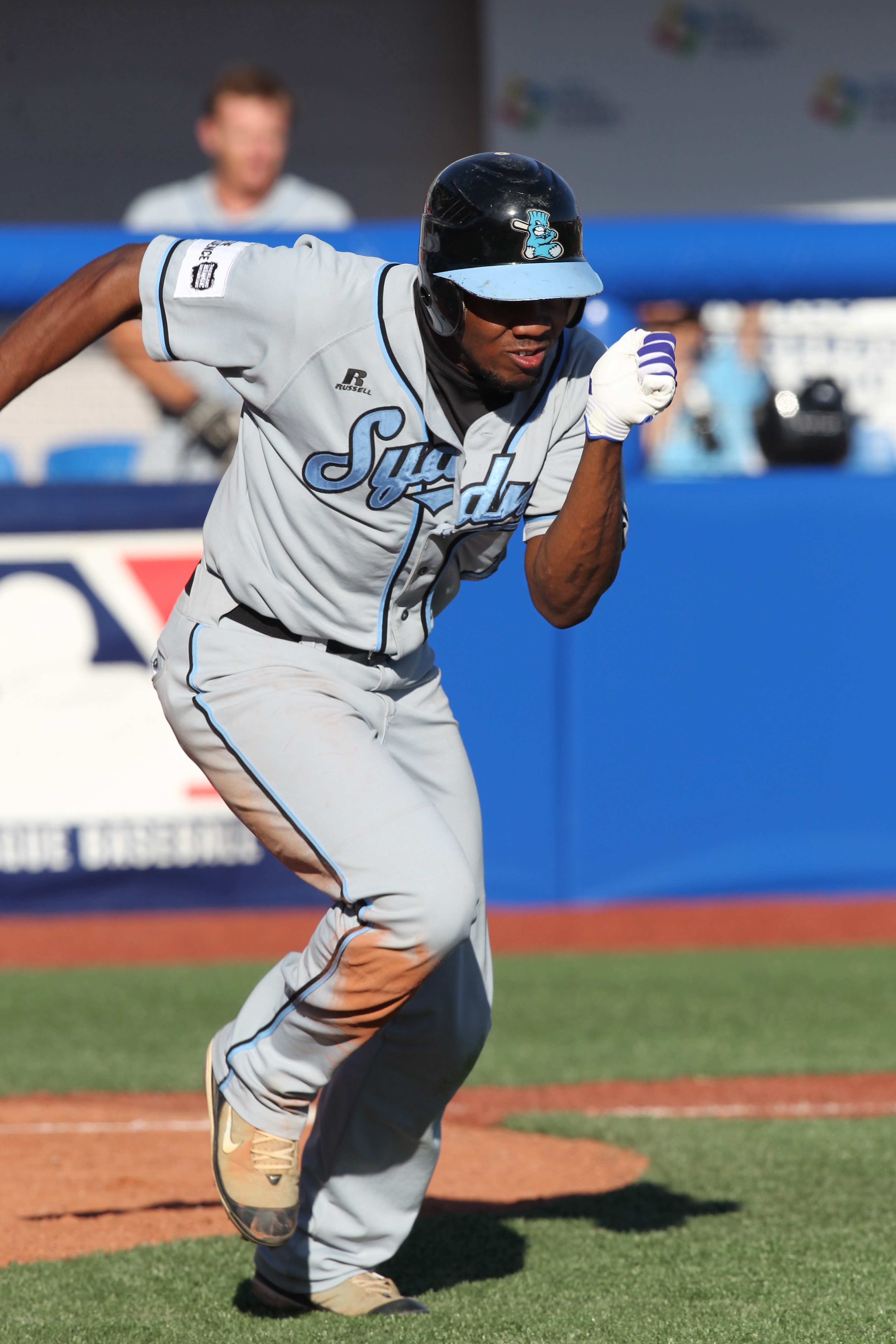
#20 Zach Penprase of the Sydney Blue Sox was 16-for-20 in ABL stolen base attempts.After being drafted by the Philadelphia Phillies in the 13th round of the 2006 MLB June Amateur Draft from Mississippi Valley State University, #20 Zach Penprase spent the following three years honing his skills in Single-A ball within the Phillies and Red Sox organizations. Despite being released from MiLB in 2008, the talented infielder was determined not to give up playing baseball professionally. When the Fargo-Moorhead RedHawks offered refuge from the minor league madness, he gratefully accepted the invitation and has since become a leader and fan favorite in the Independent American Association League for the past three seasons. Making waves across the U.S. that were felt as far as Bondi Beach, Penprase got the attention of Sydney Blue Sox GM David Balfour. Given the opportunity to redeem himself in front
of MLB scouts while experiencing unrivaled Aussie hospitality in the ABL, the 27-year-old Southern California native signed up to play ball in the state capital of New South Wales. #20 Zach Penprase with Blue Sox teammates (Photo courtesy of Joe Vella / SMP Images / ABL)Representing Team World in the ABL All-Star game at the end of round six of ABL action, Penprase was one of the top three hitters in the league with the second-best batting average (.370) and the third-best on-base percentage (.469). Setting new team records in games played (45) and stolen bases (16), the Sydney Blue Sox second baseman and shortstop proved to be a valuable American import with a respectable season-ending .282 batting average and
.365 on-base percentage.
One last thank you from all the way across the globe to all Aussies and especially to @sydneybluesox for never saying a bad word about me.
#19 Quincy Latimore of the Adelaide Bite (Photo courtesy of Sarah Lee / The Advertiser)Recently traded from the Pittsburgh Pirates to the Cleveland Indians, prospect Quincy Latimore returned for his second ABL season in 2013.
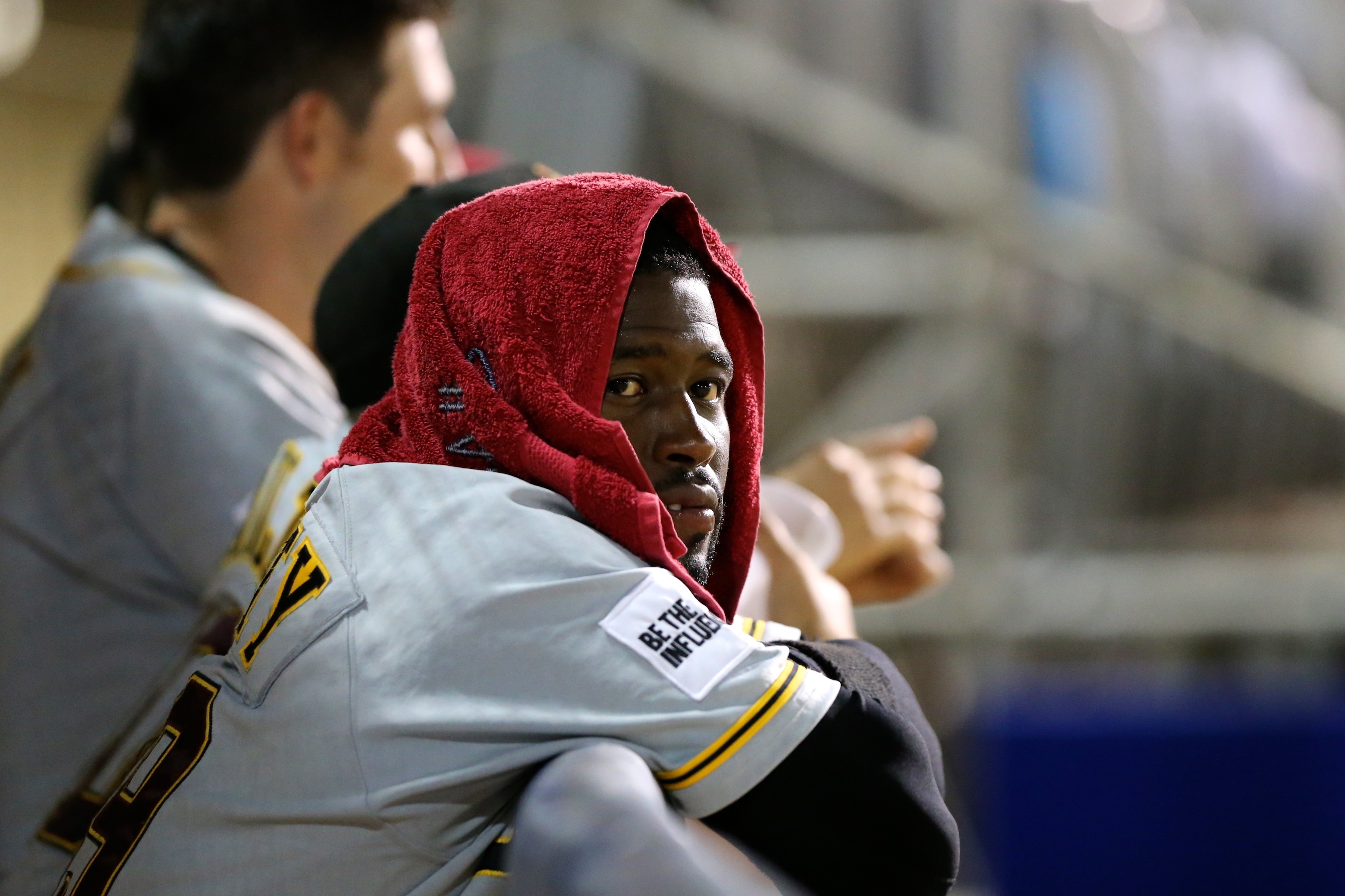
(Ryan Schembri/SMP Images/ABL)#19 Quincy Latimore replaced injured Pittsburgh Pirates prospect Justin Howard on the Adelaide Bite roster shortly after Christmas. He was a welcome addition to the team’s ailing line-up after an impressive 2010 ABL campaign in which he played in 31 games for Adelaide with a .313 batting average and was sixth in the ABL in both slugging percentage (.548) and on-base plus slugging percentage (.923). Selected in the fourth round of the 2007 draft by the Pittsburgh Pirates out of Middle Creek High School in Apex, North Carolina, Latimore competed in rookie ball until 2010. While at Single-A Advanced Bradenton, the left fielder crushed 19 homes runs with 100 RBI and earned Florida State League post-season All-Star honors. In each of his last two seasons at Double-A Altoona, he has hit 15 homers, while exercising more plate discipline by taking more walks and cutting down on strikeouts. With a minor league career .255 batting average, Quincy Latimore was recently acquired by the Cleveland Indians in exchange for the MLB-experienced right-handed pitcher Jeanmar Gomez. The 24-year-old put together a .286 batting average and a .400 on-base percentage in 16 games for the 2012-13 Bite.
Finally off to Australia! Lets hope this flight goes by fast! 😒
#18 Brenden Webb of the Perth Heat#18 Brenden Webb was drafted by the Baltimore Orioles as a 19-year-old in the 30th round of the 2009 amateur draft out of Palomar Community College in San Diego County. Ranked #31 by Orioles Nation in their 2013 Top 50 Baltimore prospects feature article, lefty outfielder is a five-tool player with potential to make a positive impact on the major league level. His aggressive defensive prowess is demonstrated in this youtube video of him throwing out Canberra’s Kody Hightower at the plate. Featured in last season’s Top 20 Americans in the ABL article after hitting .270 and ranking fourth-best in walks (25) with only 100 at-bats, Brenden Webb returns again in this season’s Top 20 despite having only joined Perth in early January. In 2012 between his stints at Single-A Delmarva and Single-A Advanced Frederick, the 23-year-old power-hitter had career-highs in both walks (98) and home runs (14) while greatly increasing his on-base percentage.Baltimore Orioles prospect Brandon Webb displayed raw power in his limited at-bats in the ABL in 2013. Of his 11 regular season hits for the Heat, five were home runs.
Heading back to the states. Thanks @perthheat for the amazing time. The great fans and people is what makes Perth so special to me.
#17 K.C. Hobson of the Canberra Cavalry was named to the ABL Team World All-Stars roster but could not play due to a calf injury. (Photo by Adam East/ozcards.blogspot.com) Named ABL Player of the Week for Round One of 2012-13 action, #17 K.C. Hobson of the Canberra Cavalry absolutely raked at the plate by going 6-for-10 and hitting two home runs in three games. Named to the ABL World All-Stars roster after being Canberra’s most consistent bat as well as their clean-up hitter from the moment he set foot in Australia’s capital city at the start of the season, the aspiring 22-year-old Toronto Blue Jays prospect’s time in the ABL was cut short by a calf injury which prevented him from playing against Team Australia in the 2012 ABL All-Star game and sent him home early before Christmas. Picked up by the Jays in the sixth round of the 2009 draft out of Stockdale High School in Bakersfield, California, Hobson had a breakout year in 2012 for Single-A Lansing–where he hit .276 and set a single-season franchise record 43 doubles. The Cavalry first baseman’s injury cost him a possible ABL batting title as his average plummeted from a league-leading .600 to a season-ending .271.
#16 Jim Schult of the Brisbane Bandits had the fourth-lowest ERA (2.47) and WHIP (1.12) in the Australian Baseball League. (Photo courtesy of Charles Knight / SMP Images / ABL) #16 Jim Schult of the Brisbane Bandits was named the 2011 Division III National Player of the Year while playing at Eastern Connecticut State University. A First Team All-American Collegiate Pitcher, Schult joined the Can-Am NYSL Federals in 2011 and the Frontier League’s Joliet Slammers in 2012. With unlimited potential and a bright baseball future ahead, the 23-year-old New Yorker made a great debut pitching in the ABL with a superb 4-2 record and will be welcome back.
#15 Zachary Arneson of the Melbourne Aces
(Photo courtesy of Brett Crockford / SMP Images)#15 Zachary Arneson of the Melbourne Aces was drafted by the San Francisco Giants out of Cal State Bakersfield in the 21st round of the 2010 draft, but chose to return to college and transfer to Lewis-Clark State in Lewiston, Idaho. After posting a 2-1 record with a 2.82 ERA and 46 strikeouts in his senior year, he was drafted by his favorite team–the New York Yankees–in the ninth round of the 2011 draft. The hard-throwing relief pitcher signed immediately
and has since moved up the ranks
rapidly to Single-A Charleston.
New York Yankees pitching prospect Zachary Arneson Marred by nagging injuries throughout his brief minor league career, Arneson was used primarily in a setup role out of the bullpen during 2012 and pitched two scoreless innings in his last outing for the Single-A Charleston RiverDogs to earn his only victory (1-0) before heading to Australia. The day news got out that the Melbourne Aces had scored the first American import affiliated with one of the most prestigious MLB franchises to play in the ABL, the entire Australian state of Victoria buzzed with anticipation. Melbourne Aces general manager Windsor Knox said, “It’s a fantastic day for the Aces and our fans to be associated with the New York Yankees. We look forward to seeing Zachary’s contribution to the team’s success this season.” Aces manager Phil Dale commented that it was great for the ABL to have the biggest team in the world willing to send out players. With opponents failing to connect with the 24-year-old flamethrower’s fastball early on, Arneson rightfully earned a spot on the ABL World All-Star team roster and continued to dominate with a 1.77 ERA and 24 strikeouts in 20.1 innings.
@zacharneson In Melbourne 3 months and already know who runs this City. You just claimed your Victorian citizenship mate!
#14 Anthony Claggett of the Perth Heat made his MLB debut on April 9, 2009 for
the New York Yankees and also played that same season for the Pittsburgh Pirates.
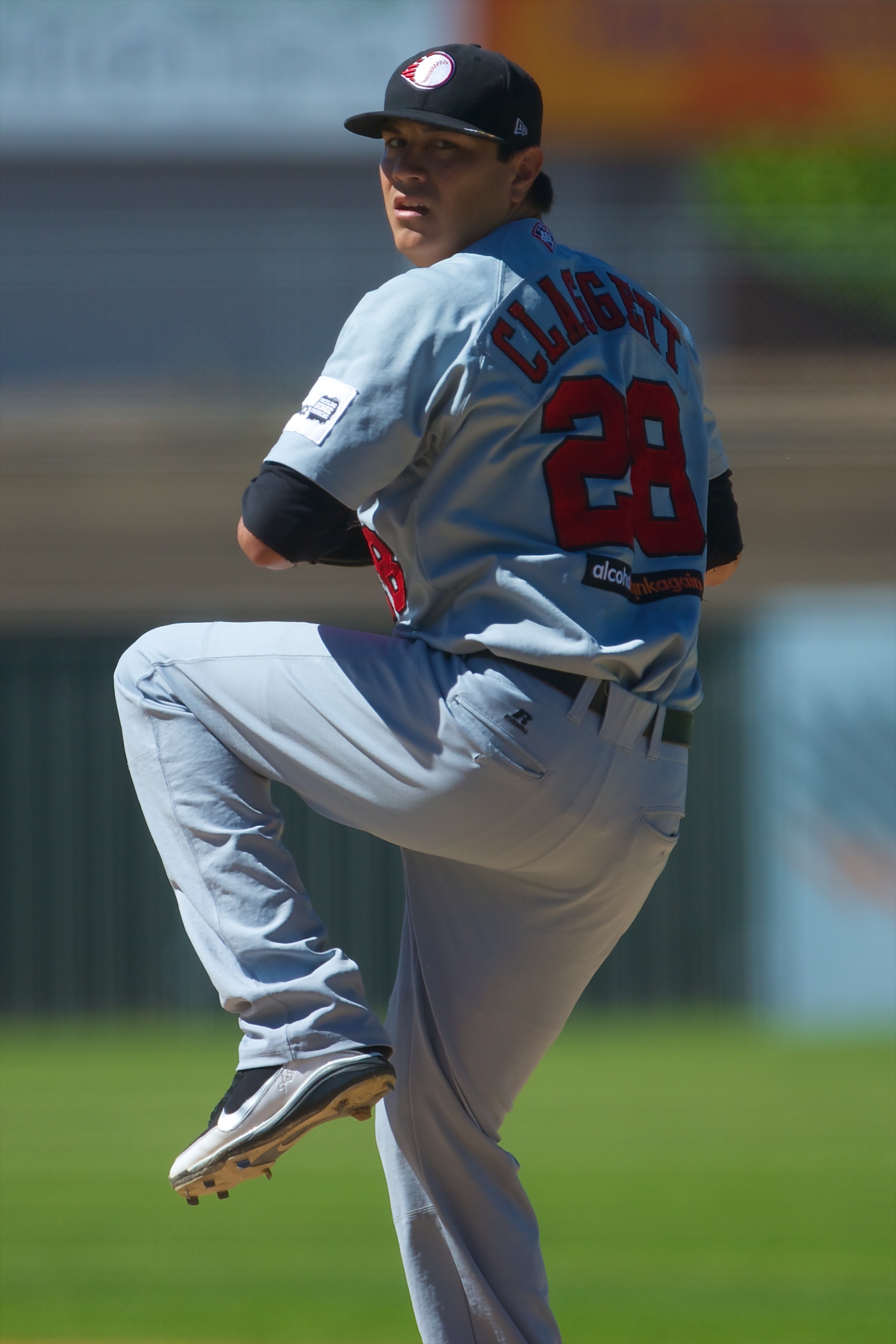
#14 Anthony Claggett of the Perth Heat (Photo courtesy of
Ryan Schembri / SMP Images) Originally selected by the Detroit Tigers in the 11th round of the 2005 draft out of the University of Califoria, Riverside, #14 Anthony Claggett of the Perth Heat was acquired by the New York Yankees in the 2006 Gary Sheffield trade. Equipped with a sinking 92 mph fastball and a 85 mph slider, the Southern California hurler came into 2009 Yankees Spring Training as the 26th-ranked prospect in the franchise and the third-ranked right-handed relief pitching prospect. Five months after making his MLB pitching debut on April 18, 2009 against the Cleveland Indians, Claggett was claimed off waivers by the Pittsburgh Pirates. He was designated for assignment by the Pirates when Octavio Dotel was acquired in 2010 and was granted free agency at the conclusion of the 2011 season. Prior to signing on with the Perth Heat in the ABL, he pitched for the Somerset Patriots and the St. Paul Saints. The 2012 ABL Team World All-Star (4-5, 3.31 ERA) was second-best in strikeouts (77) and was also named ABL Pitcher of the Week for Round Five after throwing 6.2 innings of shutout ball against the Aces with seven strikeouts and no walks allowed.
I’m very happy to be apart of the #perthheat family. We’re going to the ship #Heat3Peat
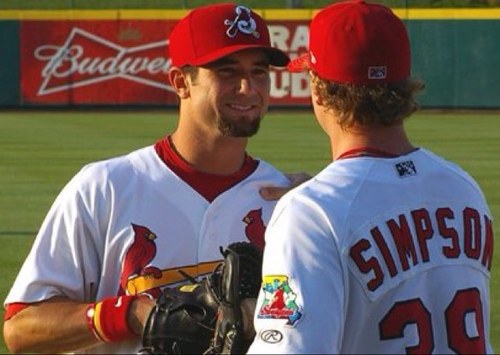
Vaughan Harris and Geoff Klein of the Sydney Blue Sox (Joe Vella / SMP Images)#13 Geoff Klein of the Sydney Blue Sox was drafted by the Saint Louis Cardinals in the 15th round of the 2010 draft from Santa Clara University in Northern California, where the switch-hitting 2009 West Coast Conference batting champion was named a 2010 preseason All-American. The 24-year-old Huntington Beach catcher and first baseman has fared well in the Cardinals minor leagues. He set career-highs in games played (102), home runs (7), RBIs (34) and walks (30) in his second season for Single-A Advanced Palm Beach prior to joining the Blue Sox in the ABL. Klein was the unsung hero calling games behind the plate for Sydney as
the Blue Sox pitching staff was the ABL’s best with the league’s lowest ERA (2.91) and WHIP (1.20). He also produced offensively for the squad–ranking third in doubles (10) and walks (20) and fourth in hits/runs (43) and RBI (21).
Last day in Oz. Bittersweet, leavin behind a lot of good mates and great experiences but can’t wait to get home and back to the grind #2013
#12 Carlo Testa of the Melbourne Aces was voted by the public as the recipient
of the second annual ABL Fan Choice Award. Italy’s Alex Maestri won in 2012.
Thanks to everyone that voted for my mate Carlo Testa.He came out on top as the ABL’s Fan Choice Awards.Well done my man! #goaces
Kansas City Royals prospect & ABL All-Star Carlo Testa#12 Carlo Testa of the Melbourne Aces beat out 29 other players for this year’s ABL Fan Choice Award. The Kansas City Royals’ selection in the 18th round of the 2008 draft out of Belmont University in Nashville, Tennessee was a 2012 Texas League Mid-Season All-Star as an outfielder for Double-A Northwest Arkansas with career-highs in home runs (15) and RBI (54). Playing in all 46 games for Melbourne this season,
the 26-year-old Midwestener was the driving force behind the ABL’s last place offense by leading the Ace’s regulars in nearly every category including: doubles (11), home runs (6), stolen bases (10), batting average (.294), on-base percentage (.394), and on-base plus slugging percentage (.835).
Big homer by Cody Clark to send the storm chasers to another win!!
#11 Cody Clark of the Brisbane Bandits spent six seasons in the Kansas City Royals minor leagues before embarking to play for the Brisbane Bandits in the Australian Baseball League.#11 Cody Clark came to Brisbane, Australia after spending the 2012 season with the Triple-A Omaha Storm Chasers. Bouncing between the Texas, Atlanta and Kansas City franchises, the 31-year-old journeyman has played 10 years in the minor leagues. The veteran catcher needed an outlet such like the Australian Baseball League to show-case for international MLB scouts as he entered free agency. The Arkansas native ventured over 8,600 miles to get Aussie baseball love.#11 Cody Clark was named a 2012
ABL Team World All-Star. (Photo by Brett Crockford/SMP Images/ABL) Taken in the 11th round of the 2003 draft by the Texas Rangers, Clark moved over to the Atlanta organization in 2006 before signing with Kansas City
in 2007. A fixture at the Triple-A level ever since, the versatile catcher got a lot of action in 13 games at Royals Spring Training last year. Clark was 6-for-18 for a .333 average, and he drew four walks to give himself a healthy on-base percentage of .435. Despite rubbing shoulders with the elite and handling major league pitching at camp, his MLB debut still eludes him to this day. However, his seasoned level of play in the ABL would make one think he had broken into the Bigs
a long time ago. In addition to being an ABL Team World All-Star, the Brisbane backstop was named ABL Player of the Week for Round Four. During the four-game series against the Adelaide Bite at the Norwood Oval, Clark went 8-for-15 with two home runs, two doubles, two walks, two runs scored and nine RBI. There was nothing bush league about the Bandits’ leader in hits (50), runs (25), doubles (13), and RBI (28) or nothing minor about his .299 batting average.
ABL action from Blue Sox Stadium at Blacktown International Sportspark in Sydney, AustraliaIt is believed that baseball was introduced to Australia by American gold miners in the Victorian gold rush of the 1850s. Back then miners would play baseball on the gold fields when they received time off for rest. The first reports of organized baseball teams appeared in Ballarat, Victoria in 1857. So it should come as no surprise that Americans are still playing
ball in places like Melbourne, Sydney, Brisbane, Adelaide, Canberra and Perth as participants in the Australian Baseball League. Let’s look at some of the Top 40 Americans in the ABL.#30 C.J. “Hollywood” Beatty of the Brisbane Bandits (Photo by Joe Vella / SMP Images)#30 C.J. Beatty hit his sixth homer of the season
in his final ABL game on January 26, 2013 in Sydney.
(Photo courtesy of Joe Vella / SMP Images / ABL)#30 C.J. Beatty was selected by the St. Louis Cardinals in the 26th round of the 2009 MLB June Amateur Draft after all-star play at North Carolina A&T State University in Greensboro, North Carolina. He progressed rapidly up the ranks in 2010 to Single-A Advanced Palm Beach in the Florida State League before the Cardinals farm system released him after discovering an irregular heartbeat during his 2011 camp physical. Although he was cleared to play after an EKG, the red birds acted on the side of caution with his release. The current official Twitter photo for @cjbeatty44That didn’t stop him from pursing his dream. After Independent ball stints
in the North American League (San Angelo, Edinburg, and Fort Worth)
and the American Association League (Lincoln), the 24-year-old North Carolinian relished his time in the ABL playing third base for the Brisbane Bandits. He earned the ABL Round 11 Player of the Week title after a multi-home run game in which he drove in five of the Bandits’ six runs. The former St. Louis Cardinals farmhand had hits in all four games of the Bandits’ Round 11 series, going 6-for-11 (.667) with three homers and eight RBI. Beatty led Brisbane in both slugging percentage (.483) and on-base plus slugging percentage (.845) while batting .252 during 2012-13. #29 JaDamion Williams of the Sydney Blue Sox (Photo by Joe Vella / SMP Images / ABL)#29 JaDamion Williams is the fastest prospect in the entire Minnesota Twins organization.
(Brett Crockford / SMP Images)#29 JaDamion “J.D.” Williams played in his first year in the ABL after spending three seasons in the Minnesota Twins minor league system. A 10th round draft pick by the Twins in 2010 out of high school, J.D. inked a $125,000 signing bonus and spent the first two years at the rookie level before jumping to Single-A in 2012. He struggled in his pro debut, hitting just .214 while playing primarily second base in the Gulf Coast League in 2010, but switched to the outfield while moving up to Elizabethton in 2011 and thrived. He batted .317 with 17 extra-base hits, 25 walks, and 10 steals in 50 games. Williams demonstrated that beyond tools and projection there was a talented baseball player beneath all the speed and athleticism. With the Beloit Snappers in 2012, the Florida native batted .234 and stole 23 bases in 32 attempts. The 21-year-old’s power numbers have also gone up every year, hitting one in his first season and six in 2012. Playing 37 games for the 2012-13 Sydney Blue Sox in the ABL, the switch-hitting outfielder contributed greatly to the team’s second place finish in the standings despite a lackluster .218 batting average.#28 Zac Fuesser was an Adelaide Bite nominee for the 2013 ABL Fan Choice Award.Adelaide catcher Chris Adamson and #28 Zac Fuesser discuss strategy. (Photo by Joe Vella / SMP Images) Drafted by the Atlanta Braves in the 19th round of the 2008 MLB June Amateur Draft after graduating from South Carolina’s York High School, #28 Zac Fuesser chose not to sign in favor of attending college. Yet, the left-handed hurler was snagged as a 2009 34th round draft pick by the Pittsburgh Pirates after receiving a $125,000 signing bonus. Since embarking on his professional baseball career at age 18, Fuesser has appeared in 83 games for three different minor league teams in the Pirates system and has a career 3.73 ERA. He spent his 2011 and 2012 campaigns pitching for Single-A West Virginia Power prior to joining the Adelaide Bite in the Australian Baseball League. Named to Team World in the 2012 ABL All-Star game, the 22-year-old southpaw contained Team Australia and pitched one scoreless inning. Second on the Adelaide pitching staff in strikeouts (57) in 57.1 innings of work, starter Zach Fuesser appeared in 11 games during the 2012-13 ABL season and posted a 4-4 record with a 3.61 ERA. He held opponents to a .259 batting average and had a strong 1.44 ground outs per fly outs ratio.Twitter profile photo for #27 Jonathan Jones of
the Canberra Cavalry (@JonJones707 on Twitter) #27 Jonathan Jones was drafted by the Toronto Blue Jays in the 29th round of the 2010 draft after a successful collegiate career for the Long Beach State Dirtbags. Prized for his speed, strong throwing arm and defensive prowess in the outfield, the 22-year-old Northern California native played in 90 games for the 2012 Single-A Advanced Dunedin Blue Jays and posted a .266 batting average before venturing down under in the Australian Baseball League. The Canberra Cavalry center fielder was promising in the early going (.258 BA, 1 HR, 2 SB), but unfortunately had to return home after only eight games due to a hamstring issue that shortened his ABL experience.
@abuschini Thanks bro. Give me a call when you get back to the Bay.
“I believe that Twitter is a great tool. It gives the fans access to follow their favorite players and see what they are doing, learn their likes and dislikes, and even get to see photos. It allows fans to feel like they have a personal relationship and for the athletes, and in return, it allows us to see all the fans’ love and support.” #26 Andrew Kittredge of the Adelaide Bite (Theron Kirkman / SMP Images / ABL) After a stellar high school baseball career, #26 Andrew Kittredge–a Spokane, Washington-born right-handed pitcher–was taken in the 45th round of the 2008 draft by the Seattle Mariners. Kittredge began his pro ball career after playing at the University of Washington in Seattle. He completed his first full season in the Mariners organization by splitting time between three different leagues within the farm system in 2012. Starting at Single-A Clinton before jumping up to Double-A Jackson, the 22-year-old Mariners prospect spent most of the season pitching for Single-A Advanced High Desert Mavericks. During the course of his brief 2012 elevator ride up-and-down, Kittredge made 25 appearances in 42 innings of relief and went 3-1 with a 4.07 ERA while striking out 43. Working as the 2012-13 Adelaide Bite closer in the ABL, Andrew saved six games and compiled a 3-1 record with a 4.73 ERA while striking out 25.
#25 Nathan Melendres of the Adelaide Bite (Courtesy of Theron Kirkman / SMP Images)#25 Nathan Melendres was drafted by the Seattle Mariners in the 17th round of the 2011 MLB June Amateur Draft from his hometown University of Miami Hurricanes in Florida. The 22-year-old outfielder was one of three Adelaide Bite imports to have finished the 2012 season with the High Desert Mavericks of the California League. Having only played in 23 games in 2012 during his second season in the Mariners organization, Nathan put together a .307 batting average with two home runs and 15 RBI between
his time at Single-A Advanced High Desert, Single-A Clinton and the Arizona Rookie League. However, he got his work in this off-season in 26 ABL contests. With a .245 batting average, five extra-base hits and five homers to his credit while in an Adelaide Bite uniforn, Melendres made his impression felt
in Australia and excited the Mariners’ faithful.#24 Carlos Alonso of the Brisbane Bandits (Photo by Scott Powick / SMP Images / ABL)#24 Carlos Alonso (Steve Bell / SMP Images / ABL)#24 Carlos Alonso was selected in the 32nd round of the 2010 draft by the Philadelphia Phillies after playing for the University of Delaware. The Los Gatos, California native began his collegiate baseball career at Santa Barbara City College, where he was a two-time First Team All-Western State Conference third baseman. Hitting over .360 two years straight for the Vaqueros, he started 88 consectutive games at Santa Barbara City College and led his team to the playoffs twice. University of Delaware’s Carlos Alonso Leaving the West Coast in search of more playing time, Alonso transferred to the University of Delaware and was under the guidance of head baseball coach Jim Sherman. Upon being drafted by the Phillies in 2010, Sherman was supportive
of Alonso regardless of his chosen career path. “Wherever Carlos goes, whatever he decides to do beyond baseball, whether he plays baseball for a career professionally, or goes into the business sector of the world, no matter what part of the country he’s in, he’s always going to be perceived as a class individual,” Sherman said. “I think people are just going to gravitate towards him.” Ranked #25 in Bleacher Report‘s 2012 Phillies Top 25 Positional Prospects, the righty infielder played 93 games for Single-A Advanced Clearwater and racked up a respectable .278 batting average.
Carlos Alonso A versatile utility player who can play any infield or outfield position,
the 25-year-old Phillies farmhand is valuable commodity for any team manager. While in Australia, Alonso anchored the Brisbane Bandits infield at third base. Bandits manager Kevin Jordan said, “Like a lot
of guys, Carlos got out here and you’re learning the whole league overnight, literally. You get thrown in the fire. For him, it is what
it is. I told him what was going to happen, that he was going to be thrown into it, that he was going to have to pretty much learn all
the pitchers; where to play guys defensively, on the fly and he’s starting to come around, especially with the bat.” Alonso ended the 2012-13 ABL season with a .209 batting average and seven doubles.Twitter profile photo of #23 Adam Melker of the Perth Heat (@AdamMelker on Twitter)#23 Adam Melker (Photo courtesy
of Ryan Schembri / SMP Images / ABL)#23 Adam Melker was selected by the
St. Louis Cardinals in the 44th round of the June 2010 Amateur Draft from Cal Poly San Luis Obispo. After completing his third season
in the Cardinals organization and putting up good 2012 numbers (126 games, .278 batting average, 10 home runs, 35 RBI) at Double-A Springfield, Melker was reunited with former Perth Heat manager and current Corvallis Knights skipper Brooke Knight–who took his 2011-12 Aussie champion Heat to South Korea to represent Australia in the 2012 Asia Series. Prior to arriving in mid-October to play for Perth in the ABL, the left-handed hitting slugger exuded excitement. “I’m really excited,” said Melker. “I’ve heard baseball in Asia is extremely good so I’m looking forward to the challenge. Some time off this winter would have been nice, but I couldn’t turn down and opportunity to play baseball on two other continents…”
Melker remained with the Heat until mid-December and then
returned to the United States. “I would have liked to have stayed longer,” he said. “But I needed some time off that
I could dedicate to strength training and get 100% healthy before I headed off to spring training in March.” During
the 22 ABL games Melker played in the Perth outfield,
he contributed to the Heat’s early season offensive attack
with a .247 batting average–including two doubles, two
triples, one home run, six RBI and one stolen base.Minnesota Twins prospect #22 Tyler Herr shows the umpire the ball after applying a tag in
a 2011 Gulf Coast League game in Fort Myers, FL. (Photo by Kevin Johnson / Newport News)#22 Tyler Herr, Sydney Blue Sox reliever and ABL Team World All-Star (Ben Southall/SMP Images)#22 Tyler Herr of the Sydney Blue Sox was selected by the Minnesota Twins in 44th round of the 2009 draft. Launching his pro ball career in 2010 at age 19, the intimidating right-hander from Texas now has three seasons under his belt in the Twins’ minor league system with a career 8-4 record and a 3.38 ERA. Through 90 innings pitched, Herr has allowed just 87 hits while striking out 74. Making 21 appearances for the 2012 Appalachian League champions Elizabethton Twins, the six-foot-eight hurler went 3-0 with a 2.56 ERA. After coaching the 2012 Minnesota Twins extended Spring Training rookie ball club, former Twins minor leaguer and current Sydney Blue Sox manager Jason Pospishil liked what he saw and invited Herr to join his squad in the ABL. The first-year Sydney skipper said, “He has a power sinker in the 93-95 mph range with a good slider and developing change-up. More importantly, he has a tremendous work ethic.” Herr was summoned out of the 2012-13 Sydney Blue Sox bullpen in 16 games and went 3-2 with a 3.57 ERA.#21 Justin Howard of the Adelaide Bite (Photo by Ryan Schembri / SMP Images / ABL) #21 Justin Howard (Ryan Schembri / SMP Images)#21 Justin Howard of the Adelaide Bite was both a newsreel highlight and a major letdown in Australia after the ABL Player of the Week for Round 6
(4 games played, 9-for-14 for a .643 batting average, 4 doubles, 4 RBI, and 6 runs total) sustained an elbow injury and had to return to America for surgery. In his last nine games prior to his departure, the left-handed hitting 25-year-old Bite first baseman/ DH was on a roll–going 15-for-35 with five doubles and five RBI–but left with a down-to-earth .266 batting average.
Drafted by the Pittsburgh Pirates in
the 24th round of the 2010 MLB June Amateur Draft from University of New Mexico in Albuquerque, Justin Howard has successfully been promoted each of his three seasons for the Buccos. The native Texan hit .283 with two homers and 29 RBI in 83 games for Single-A Advanced Bradenton prior to playing in the ABL. He will certainly be welcome to return to the Adelaide Bite next season.
It’s been amazing Adelaide. Sorry for the early departure but gotta get the elbow cleaned out. Back to the great state of Texas in 15 hours
The Australian Baseball League’s 2012-13 season did not disappoint the sleep-deprived stateside fans and families of American ballplayers who stayed up all hours of the night to watch a slew of talent with MLB potential. MLBblogger salutes the many American volunteers that worked tirelessly behind the scenes long before the start of the ABL season so that Aussie baseball could prosper.
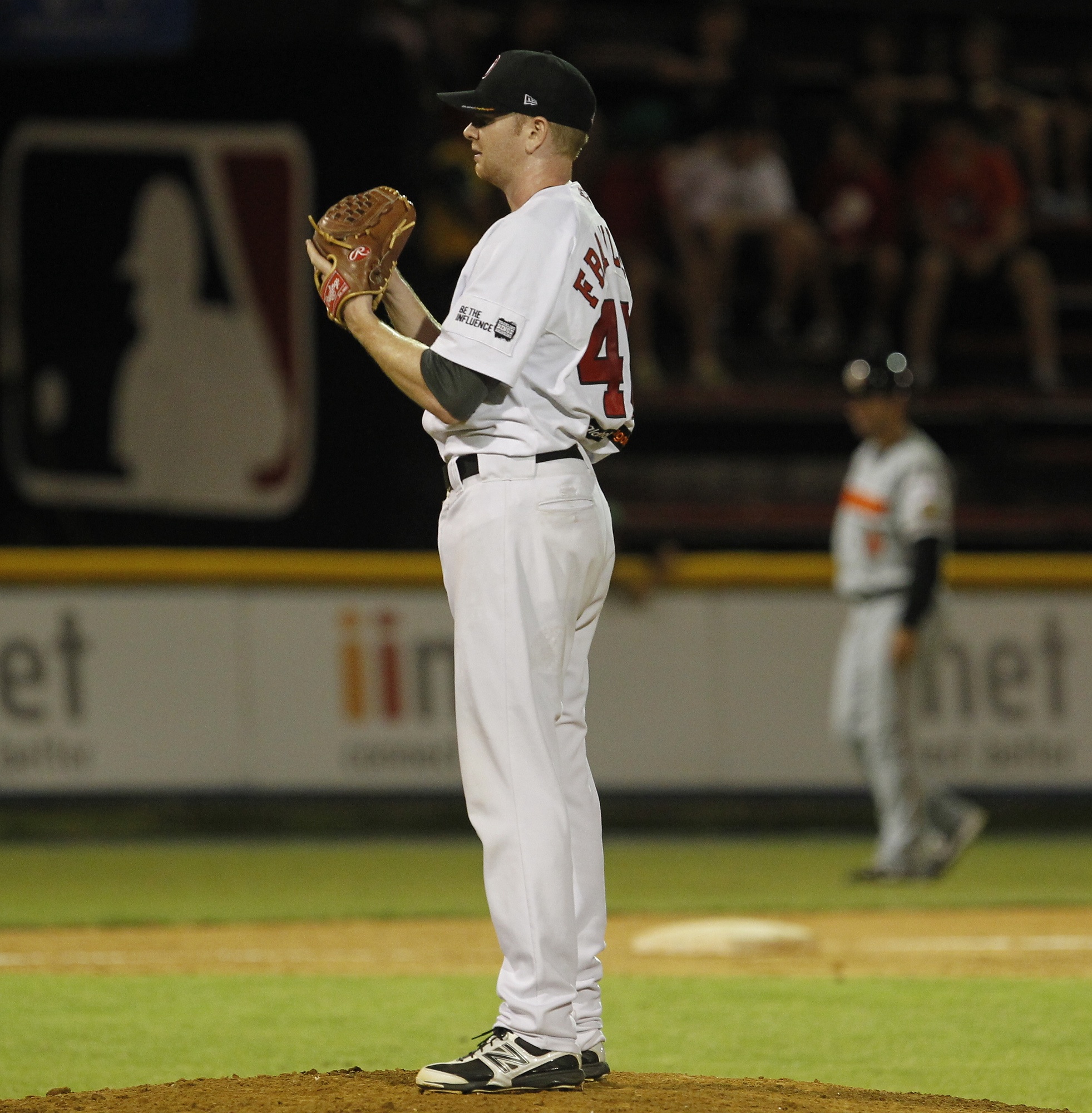
In addition to showcasing last season’sTop 20 Americans in the ABL, we have previously announced many of the 2012-13 Top 40 Americans in the ABL. Click on the highlighted player’s name to access the Top 40 American in the ABL feature article: #40 Dustin Loggins, RHP Canberra Cavalry; #39 Caleb Cuevas, RHP Sydney Blue Sox; #38 Greg Van Sickler, RHP Perth Heat; #37 Chuck Lofgren, LHP Brisbane Bandits; #36 Kevin Reese, RHP Melbourne Aces; #35 Gabriel Suarez, OF/INF Adelaide Bite;#34 Chris Motta, RHP Canberra Cavalry. #33 Jack Frawley, pitcher for the Perth Heat
(photo by Theron Kirkman / SMP Images / ABL)
#33 Jack Frawley of the Perth Heat was the winning pitcher in last year’s 13-inning marathon ABL Championship title victory over the Melbourne Aces. He hopes to help the Heat go down in Aussie baseball history with a never seen before three-peat in the ABL Championship Series against the top-seeded Canberra Cavalry. The 27-year-old once again came through in the clutch on the regular season’s final day to clinch the Heat’s third straight ABL postseason berth. Making his first start and fifth overall appearance this season (3-1, 1.21 ERA), the Cleveland-born right-hander earned ABL Round 13 Pitcher of the Week honors by throwing eight shutout innings and limiting the Melbourne Aces to just three hits. #32 Sean Toler, closer for the Canberra Cavalry (photo by Theron Kirkman / SMP Images / ABL)
A 24th-round draftee by the Colorado Rockies in 2005, #32 Sean Toler was signed by Canberra after playing with Cavalry teammates Steven Kent, Brian Grening and Dustin Loggins on the American Association of Independent Professional Baseball’s Kansas City T-Bones in 2012. The Missouri State baseball star was one of seven Cavalry players represented in the 2012 ABL All-Star game. Recently voted iiNet relief pitcher of the year, the 26-year-old Canberra closer was also named ABL Pitcher of the Week for Round Six play. Toler (2-0, 2.84 ERA) was second in the ABL with 11 saves. The six-foot-five hurler loves closing games out for a team he believes could be the next ABL champion. ”Yeah, I think we can (win the title),” Toler said with confidence.
#31 Ryan Khoury of the Perth Heat (photo by Scott Powick/SMP Images/ABL)#31 Ryan Khoury of the Perth Heat spent two seasons playing shortstop for AAA Pawtucket in the Boston Red Sox organization before being released at the age of 27. Allowing Canadian Arizona Diamondbacks prospect Carter Bell to move over to his usual third base position, Khoury rounds out an experienced Heat infield which includes MLB’s Luke Hughes. Showing signs of life after Major League Baseball with 37 stolen bases and only 12 errors committed at shortstop through 103 games for the Indy American Association’s Wichita Wingnuts last year, the 2006 Red Sox 12th-round draft pick still possesses plenty of speed and athleticism. The Utah native has made the most of his limited action in the ABL (19 games, 67 AB, .224 BA)–including a towering right field home run blast in his first Heat plate appearance. While contributing at the bottom of the line-up, the 28-year-old also solidified Perth’s defense.
Last day in Perth. Thanks to @perthheat fans and especially my teammates for welcoming me to Australia. Gonna miss my Aussie family.
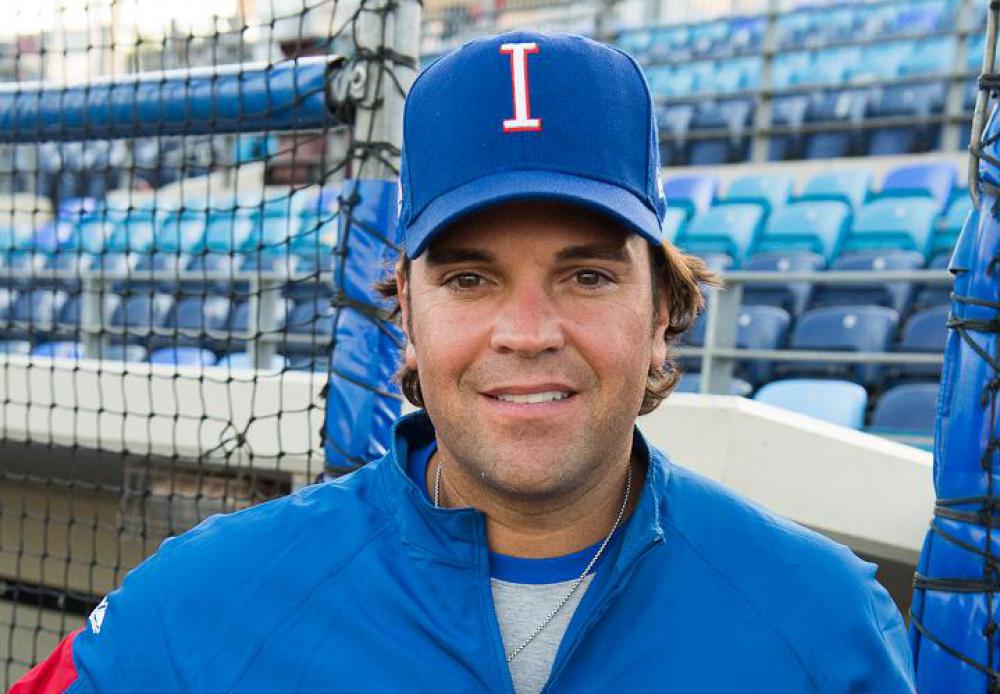
Team Italy hitting coach Mike Piazza gives
some sound advice to Anthony Granato in the 2010 European Baseball Championship Finals.Mike Piazza is a soldier recruiting a whole new generation of European athletes to play ball. “This has become a passion for me. I’m trying to help grow the game in Italy. We want to encourage the kids to play baseball in Italy and realize that you know, soccer is a great game and it’s a great game to play and everyone plays it, but baseball can be viable over there, too.” said Team Italy hitting coach Piazza. He is serious about promoting baseball abroad with Federazione Italiana Baseball Softball and exploring his deep Sicilian roots. “This commitment I have with the Italian Federation is something I really care about. I feel a strong tie to Italy, since my heritage is there. My grand-father Rosario came from Sciacca, Sicily, to the United States and my father grew me up following the Italian tradition…”
Rediscovering his ancestry in Italy and helping to make baseball relevant there are big priorities for the 12-time MLB All-Star. However, Piazza won’t deny his American upbringing. “I do not pretend to say what is not true,” he admitted. “I grew up as an American boy. Now, getting older, I understand the value of my heritage and I want to give some-thing back to Italy. I just got back from Italy, and I am doing a lot of research on my family roots from Sicily. During your baseball career, you really can’t focus on things like that because you are concentrating on playing. I’m not trying to reinvent my identity and say I’m doing the reverse Christopher Columbus thing.”
The all-time leading catcher with 427 home runs (.308 batting average) over his 16-year career and future Baseball Hall of Famer was coached by some of MLB’s best. The proud Team Italy coach Piazza said, “When I was coming up with the Dodgers I learned from Reggie Smith, and he was a direct disciple of Ted Williams. I really benefitted a lot from good coaching, so I feel I can impart my knowledge, and that is my way of giving back to the game. You can tell, obviously with our success and winning two European Championships since I’ve been there, it works…” Coaches Tommy Lasorda and Reggie Smith served as Piazza’s mentors after leading Team USA to the gold by defeating Cuba in the 2000 Olympic Games. Upon retiring as a player, Reggie Smith spent time coaching in the Dodgers’ farm system before joining Tommy Lasorda’s staff in Los Angeles, where he remained from 1994 to 1999 as the team’s batting coach and first base coach. He later served as USA Baseball’s hitting instructor
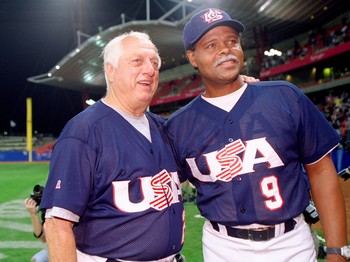
from 1999 to 2008. Piazza hopes to emulate Smith’s coaching excellence with Team Italy. He said, “The players really listen, and it’s fun for me. I get a lot of joy from doing that. I’m not a huge ‘change a guy’ type of coach, I keep it simple. I’m not very autocratic. I don’t try to pound my system into guys. To me, hitting is personal.”Tommy Lasorda and Mike Piazza love Italia! When former Team USA skipper Tommy Lasorda played against Italy in the 2000 Olympics in Sydney, the Dodger icon reflected on the sacrifice his late father, Sabbatino, made for the his family in search of a better life in America. He,
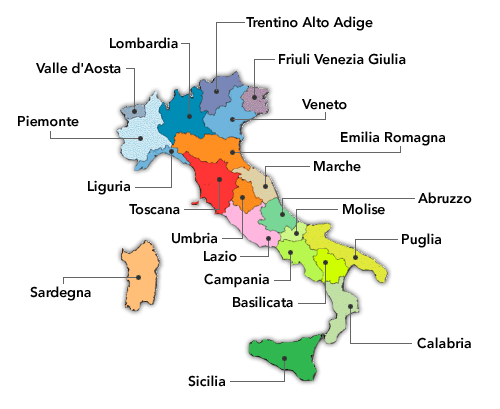
like many other Italians near the turn of the 20th century, came here from the Abruzzi region south of Rome seeking relief from the rough winters and hard terrain. However, unlike Lasorda–who wore the red, white and blue–Mike Piazza gives back to “La Squadra Azzurri” Team Italy as a fitting tribute to his grandfather Rosario from Sicilia and faces Team USA in the 2013 World Baseball Classic at Chase Field in Phoenix on March 9th.
Italian American pitcher Barry ZitoWho would have guessed that at least 454 Italian
Americans have played baseball in the majors
since 1897? The San Francisco Bay Area produced many of baseball’s pioneers and originated the
sandlot playing field in the 1860s. In fact, the
earliest West Coast games were played downtown
on a sandlot where San Francisco City Hall stands today–nearly a century before the Giants and
Dodgers arrived in 1958. So it’s most appropriate Italian Americans at Bat: From Sand Lots
to the Major Leagues, a lavish documentary
exhibition of baseball memorabilia celebrating
the vast contributions of Italians Americans to
baseball, be on display for FREE in Reno, Nevada
at the magnificent Arte Italia through May 19th.
Located at 442 Flint Street, Arte Italia is open
Thursday through Sunday from noon to 5 PM
(www.arteitaliausa.com). The chronologically-
arranged exhibition was originally curated by
the Museo Italo Americano, the Italian American Museum of San Francisco, which explains why
there is a strong emphasis on Bay Area teams. However, it plays out perfectly for the climactic
finish to the showcase: an autographed cap
and jersey worn by 2012 World Champion
San Francisco Giants’ lefty starter Barry Zito,
who won the opener of the 2012 World Series.Ed Abbaticchio was probably the first person with an Italian last name to play professionally when he broke into the major leagues in 1897.
The exhibit’s co-curator, writer and historian Lawrence DiStasi of Bolinas, has loved the game since rooting for the New York Yankees as a child and playing baseball in the streets of Connecticut. In addition to writing all the text panels for the exhibition, DiStasi weaves together ideas, stories and statistics to depict the Italian American experience. There is a timeline of the years 1845 to 2012, which includes historical points of baseball and Italian immigration into the United States–and most importantly when those two histories intersect. The exhibition highlights several decades: the early days of redefining cultural stereotypes, transcending national barriers in the 30s and 40s, improbable triumphs of the 50s, 60s and 70s, the pride of the modern era, and a dominant presence in the Hall of Fame. Joe DiMaggio is the coveted star of the exhibition, and his 56-game hitting streak in 1941 is accented by DiStasi’s text panels which document each hit recorded in the “Dimag-o-Log” that SF Chronicle ran in the Sporting Green every day. Joe DiMaggio, along with his brothers–
Dom and Vince, Tony Lazzeri, Frank Crosetti, Babe Pinelli, Ernie Lombardi, Rugger Ardizoia, Billy Martin and Jim Fregosi are among the celebrated Italian American players with strong baseball roots to the Bay Area. San Francisco-born Francesco Pezzolo changed his name to Ping Bodie to avoid bias and ridicule for Italian last names.Undoubtedly Italian Americans have made important contributions to the game, but
perhaps just as poignant is the profound
effect baseball has had on the Americanization of Italians. Faced with Italian-born parents who opposed his participation in pro baseball and regarded the sport as juvenile as well as not the wisest career choice–Ed Abbaticchio, probably the first person with an Italian surname to play professionally in 1897, was offered a hotel by his father if he would stop playing baseball. Despite the temptation, the ballplayer refused the bribe and pursued his passion for the game. However, some could not withstand the pressure and caved in to discriminatory bias and the constant ridicule sports writers bestowed upon Italian names. Among them was Francesco Pezzolo, who chose a California mining town as his name-sake and became Ping Bodie–the big league center fielder who played from 1911 to 1921.
Overcoming cultural bias throughout his career, Joe DiMaggio was the first Italian American to be inducted into the Baseball Hall of Fame in 1955.Italian Americans at Bat: From Sand Lots to the Major Leagues traverses the U.S. cultural landscape and documents an ethnic group’s rise from adversity by celebrating its triumphs in breaking into a sport dominated by English, Irish and German immigrants. However, even the game’s greatest stars had to contend with deep-rooted prejudices and stereotypical misnomers. A May 10, 1939 Life magazine cover story on Joe DiMaggio was laced with gross innuendos: “Instead of olive oil or smelly bear grease he keeps his hair
slick with water. He never reeks of garlic and prefers chicken chow mein to spaghetti.”After Japan bombed Pearl Harbor on December 7, 1941, the United States declared war
and began targeting those of German, Italian or Japanese descent. The Italians were the largest immigrant group in the U.S. at the time and about 600,000 of the country’s five million Italian immigrants who had not yet naturalized were forced to register as enemy aliens. Required to carry photo ID booklets and surrender flashlights, shortwave radios, guns, binoculars, cameras and other “contraband,” Italian enemy aliens were subject to FBI raids and nightly house arrest with a curfew from 8 PM to 6 AM. Noncitizens could not travel more than five miles from home without a permit. Lawrence DiStasi, author of “Una Storia Segreta: The Secret History of Italian American Evacuation and Internment during World War II”, reports that 10,000 Italians in California were evacuated, mostly from coastal areas and sites near power plants, dams and military installations. Ironically, the half-million Italian Americans serving in the U.S. armed forces at the time of the crackdown were the largest ethnic group in the military. Of the 257 Italians put in internment camps for up to two years, 90 were from California. Fishing boats were seized, and thousands of fishermen lost their jobs. In San Francisco, 1,500 people–including Joe DiMaggio’s parents–were idled. “The opportunity to showcase the adversity and accomplishments of legendary Italian American baseball players is one we welcome and relish,” said Kristen Avansino, President and Executive Director of Arte Italia. “For them, it was a way to integrate into the American way of life,” added Arte Italia Program Director Annie Turner. The exhibition brings home
the message that baseball allowed Italian Americans to assimilate into popular culture:
“This most American of sports became a quick way to counter that negative immigrant identity as an outsider.” Phil Rizzuto, Yogi Berra, Rocky Colavito, Roy Campenella, Ron
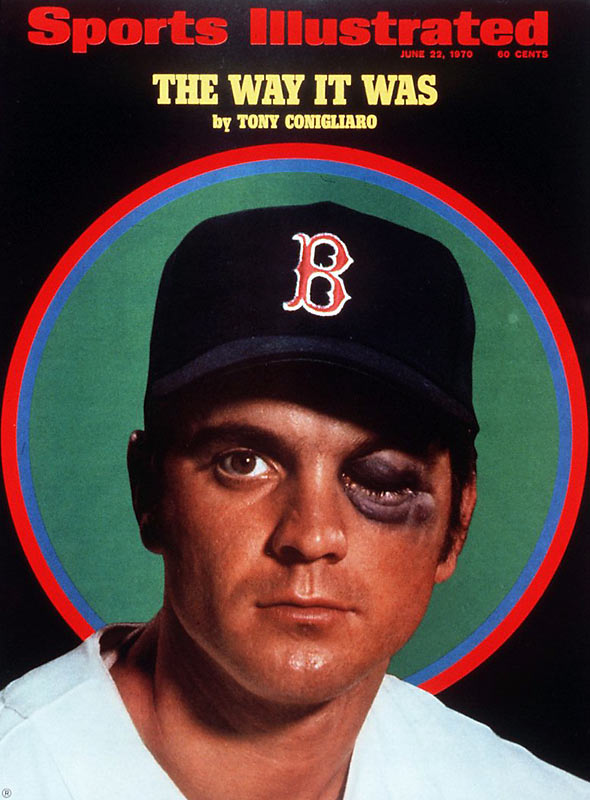
Santo, Carl Furillo, Joe Caragiola, Sal Maglie, Tony Conigliaro, Tommy Lasorda, Joe Torre, Tony La Russa, Mike Scioscia, Ken Caminiti, Craig Biggio, Mike Piazza, Mike Napoli and
former Commissioner of Major League Baseball Bart Giamatti are just some of the legendary Italian American baseball ambassadors that have etched their names into U.S. sports history forever.Italian Americans at Bat: From Sand Lots to the Major Leaguepays tribute to their contributions, and those of over 400 others who have left their unique imprint
on the game. Currently on display in Arte Italia’s upstairs Michelangelo and Leonardo
da Vinci galleries are vintage jerseys, a plethora of memorabilia–including classic baseball cards and autographed baseballs, press clippings of career milestones, an interactive
touch screen computer database featuring memoirs, stats, and career highlights of
Italian American players and 14 World Series Championship managers as well as
over 200 archival photographs of some of the greatest moments in baseball history.In celebration of the upcoming April 2013 paperback release of his book “Beyond DiMaggio: Italian Americans in Baseball” (University of Nebraska Press) author and 2006 World Baseball Classic Team Italy interpreter Lawrence Baldassaro visited the Italian Americans at Bat Exhibition.The 2013 World Baseball Classic Championship Round begins March 17th at AT&T Park in San Francisco, CA. With game one of the WBC Semifinals beginning Sunday evening, March 17 at San Francisco’s AT&T Park, fans have plenty of time to see the Italian Americans at Bat Exhibition at Arte Italia. You might even find Team Italy downstairs eating an inspirational pre-game meal prepared by Master Chef Paolo Sari, who has created three distinct regional menus reflecting the culinary traditions of Joe DiMaggio (Sicilia), Tony Lazzeri (Toscana) and Frank Crosetti (Lombardia). Buon appetito! Forza Italia!! Forza Azzurri…
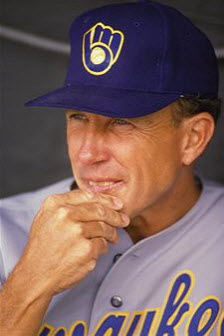
Tom Trebelhorn managed the 1986-1991 Milwaukee Brewers
and the Chicago Cubs in 1994.Italians have often been criticized for using their
hands when they speak, but 2009 Team Italy coach Tom Trebelhorn (who is of German descent) has
been chastised by Cubbie fans for speaking his mind. To the dismay of the Chicago faithful, the former
MLB manager was awarded the #1 quote in Bleacher Report‘s “Best Baseball Quotes of All Time” (which includes memorable quotes from Italian American Baseball Hall of Fame Legends Joe DiMaggio and Phil Rizzuto). However, Trebelhorn would much
prefer being remembered in baseball history for
his invaluable contribution in preparing the Italian team for the 2009 World Baseball Classic. “I think
the global aspect of baseball is very exciting,” said
the seasoned 65-year-old baseball veteran. He loves the international platform that the World Baseball Classic provides. Trebelhorn commented, “It gives
the game terrific exposure. To be able to hopefully
help the Italian Baseball Federation in their attempts
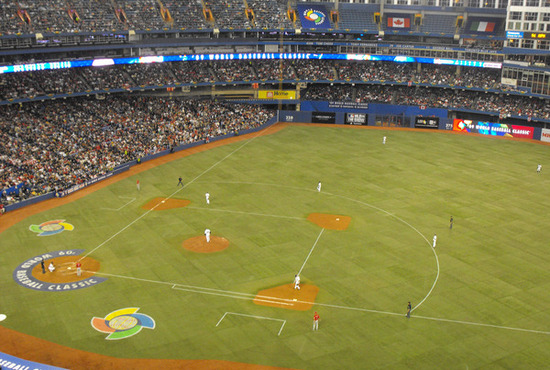
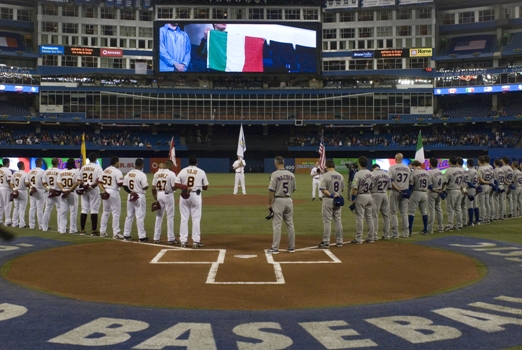
to enrich baseball as a sport in Italy is intriguing.”Bird’s-eye view of the 2009 WBC game between Italy and Canada at Toronto’s Roger Centre.’09 World Baseball ClassicEvery minute with the Italians in the 2009 World Baseball Classic at Rogers Centre was special for Trebelhorn. “A great experience. The team played with a lot of passion and heart,”
he said in retrospect to Italy’s 6-2 upset and elimination of
host Canada. “That was an embarrassment to them.” Named 1986 Manager of the Year by Baseball America after posting
an impressive 91-71 in his first season as the Milwaukee Brewers’ skipper, Trebelhorn managed the Brew Crew through 1991. After managing the 1994 Chicago Cubs, he signed on as coach for the Baltimore Orioles and remained with the franchise for 12 years. An unlikely alliance between the O’s and the Italian League’s Grosseto Baseball Club began after Baltimore County and the Italian Province of Grosseto became Sister Counties.The Sister Counties relationship between Baltimore and Grosseto blossomed as a result of the friendship between Orioles coach Trebelhorn and Grosseto native/Italian manager Mazzieri.Italian manager Marco Mazzieri The late and great Orioles vice president of operations
Syd Thrift announced in 2001 that Grosseto Baseball
Club manager Marco Mazzieri and several of his players were invited to Orioles’ Spring Training to observe team workout and training methods. He said, “We believe
this will help advance the game of baseball in Italy and throughout Europe. I’ve been to Grosseto and have
seen the enthusiasm they have for the game of baseball.” Italian manager Mazzieri and O’s coach Trebelhorn were two sound baseball minds from different sides of the Atlantic, and their common love for the game brought them together around the same time every year. They became close friends in no time and looked forward to their annual reunion. Trebelhorn said, “I used to have
him come to spring training and work with us in Florida.” When Federazione Italiana Baseball Softball (FIBS) President Riccardo Fraccari revealed that Mazzieri would be manager for Team Italy in the 2009 World Baseball Classic, the Italian baseball icon knew he needed some reinforcement with extensive MLB experience behind him. Upon hearing
of his appointment Mazzieri said, “I am really happy and not overconfident.
I am aware of the fact that I need to rely on the experience of a coach who has spent time in the Big Leagues.” Mazzieri summoned Trebelhorn. “He got the job as the head guy and asked if I would help him out,” said Trebelhorn nonchalantly. As the saying goes: “A friend in need is a friend indeed.”
Team Italy catcher Tyler LaTorre was instrumental in the Italians’ conquest of their
third consecutive European Championship by defeating IBAF #7 ranked Netherlands.SF Giants managerial assistant Tom Trebelhorn encouraged Tyler LaTorre to play for Team Italy.Inspired by the power of suggestion from 2009 Team Italy bench coach and current Giants’ Spring Training / Short Season Single-A affiliate Salem-Keizer Volcanoes managerial assistant Tom Trebelhorn to join the Italian national team, 29-year-old catcher Tyler LaTorre takes his strong 2012 campaign for Triple-A Fresno Grizzlies and Team Italy in the European Championship into the 2013 World Baseball Classic beginning March 7th. After winning their third consecutive European Championship, the Italians
are now positioned at #9 in the IBAF 2012 (year-end) Men’s World Ranking.
World Baseball Classic Championship Round play begins March 17th at AT&T Park in San Francisco. Nothing would make the Santa Cruz-born LaTorre more excited than Italy advancing to his home turf in the Bay Area for the World Baseball Classic Championship Round at AT&T Park in San Francisco. The Giants prospect, who signed as a free agent in 2006, has earned the right to play in front
of his hometown crowd after nearly winning Euro Championship tourney MVP honors. Eight of his 14 hits (14-for-28, .500 BA) were for extra bases (six doubles and two home runs). He absolutely raked at the plate, knocking in nine RBI and scoring nine times.Giants minor leaguer Tyler LaTorre catching for the Triple-A Fresno Grizzlies on May 24, 2011. “We had one goal and that was to repeat as European champions,”
said LaTorre. “It was awesome. I’m definitely thankful to the Giants for letting me go.” The former University of California, Davis and Aptos High School All-Star catcher has spent seven years in the Giants organization for a chance to shine in the World Baseball Classic.
LaTorre’s Italian roots trace back to his great-grandparents in Italy. It took two and a half years for him to become eligible to play for Team Italy as a dual citizen and Italian passport holder after thorough research, documentation and tedious paperwork authenticating his Italian lineage. Adding his minor league experience plus the time served in Italian purgatory, Tyler LaTorre has waited nearly a decade to become Italy’s secret weapon in the WBC.
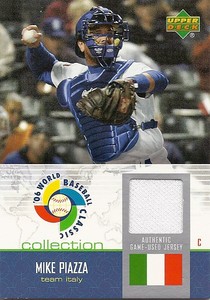
Mike Piazza played for Team Italy
in the 2006 World Baseball Classic.Mike Piazza’s double and Jason Grilli’s near-perfect 4.2 innings of pitching, which prompted a standing ovation from the sold-out crowd at Lake Buena Vista’s Walt Disney World Resort in Florida during Team Italy’s 10-0 win over Australia in the first round of the 2006 World Baseball Classic, may have something to do with it. Perhaps the perks of being an Italian ballplayer including the sweet aroma of the delicious post-game Sicilian cuisine-inspired victory celebrations in the club house was appetizing enough for Piazza to make what seemingly could become a lifetime commitment to one’s country of ancestry. With over five years of service to date under his belt, the one-time Marlin and current Team Italy hitting coachMike Piazza is a big catch for the Federazione Italiana Baseball Softball (FIBS) by inspiring a whole new generation of Italian athletes and furthering baseball’s reach in Europe. “The biggest thing for me is trying to promote the game in Europe,” Piazza said.Mike Piazza celebrates with Team Italy after the Italians beat the Netherlands to win their third consecutive European Championship since 2010.
Like a gondolier in Venezia, Piazza is singing songs of praise for the World Baseball Classic. He said, “I believe in it. I think it’s great. I hope someday down the line it turns into a world-class, World Cup-type thing. I think that’s in conjunction with the way the game is evolving and changing. One of my personal mottos is: ‘If you are going to do it, don’t do it halfway.’ If they’re going to really make a concerted effort to develop the Classic, truly make it a world event.”
2013 World Baseball Classic Pool D play begins on March 7th when Italy battles Mexico at Salt River Fields at Talking Stick in Scottsdale. The Italians return March 8th to take on Canada. Team Italy travels to Chase Field in Phoenix on March 9th to face Team USA. The winner and runner-up of Pool D will advance to the second round of a modified-double elimination tourney. Italy hopes to make it to the WBC Finals at AT&T Park in San Francisco, CA.The two teams will play the winner and runner-up of Pool C (which includes Venezuela, the Dominican Republic, Spain and host Puerto Rico) beginning March 12th at Marlins Park in Miami. The winner and runner-up of the stiff competition will move on to the WBC Championship Round starting March 17th at AT&T Park in San Francisco. Not only does Piazza believe in the WBC, but he also has faith in Italian baseball. Having already coached Team Italy to two of its three consecutive European Championships and hinting of a WBC title, he said: “Our dream one day is to have this team be a champion.”
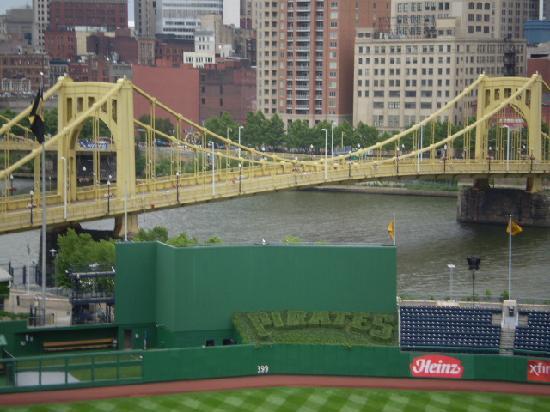
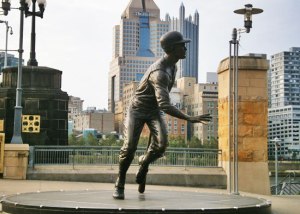
The Roberto Clemente Bridge leads Grilli and Pirates fans to PNC Park in downtown Pittsburgh.Vittorio Grilli is currently
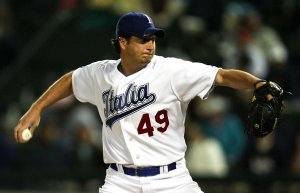
the Italian Finance Minister.“I told the cab driver, just rolling up over the Clemente Bridge and going around the corner, I said, this is my office space,” said Pittsburgh’s new closer Jason Grilli after signing his two-year, $6.75 million contract through 2014 with the Pirates. “This is how I do my best work. There’s sometimes not enough money that can be a good tradeoff to being comfortable and to know what to expect.” Despite leaving money on the table and taking far less than the free agent market offered to stay in Pittsburgh–much to the disliking of Italian Finance Minister Vittorio Grilli, 36-year-old pitcher Jason Grilli remains a Pirate.Jason Grilli established career highs in appearances (64) and strikeouts (90) with a career-best 2.91 ERA while holding opposing hitters to a .207 batting average in 2012.However, Jason Grilli has earned the right to pitch wherever he chooses after picking up the win in Team Italia’s 10-0 shutout of Australia in the 2006 World Baseball Classic (WBC) and a save in Italy’s 6-2 upset over heavily-favored Canada in the 2009 WBC competition. It goes without saying that the sight of Jason Grilli wearing an Azzurri jersey brings more joy and glory to the near-bankrupt European nation than any Italian politician could ever produce.Jason Grilli pitching for Team Italia in the 2006 WBC. Yet, politics somehow infiltrated into Italian baseball during the 1996 Olympics. After being invited by the the Italian Baseball Federation to join the country’s Olympic team while playing college ball at Seton Hall, Grilli stood proud and was honored with a parade in his hometown of Syracuse, New York. When joining the team with another Italian American pitcher, they did not receive a warm reception. The other players on the Italian squad that qualified for the Olympics without the two imports threatened a boycott.
Facing an ‘us or them’ ultimatum, the pitchers were dismissed. “I was in tears the whole way home,”
Grilli said. “The good part of it was I got to see Italy, but the worst part of it was it was a once-in-a-lifetime opportunity and I didn’t get to play.” Grilli traces his family heritage roots to Florence and Naples. He said, “I’m 75 percent Italian. My last name is every bit as Italian as you can get. The name on the front of the jersey is always more important than the name on the back, but in this case, the two go hand-in-hand.
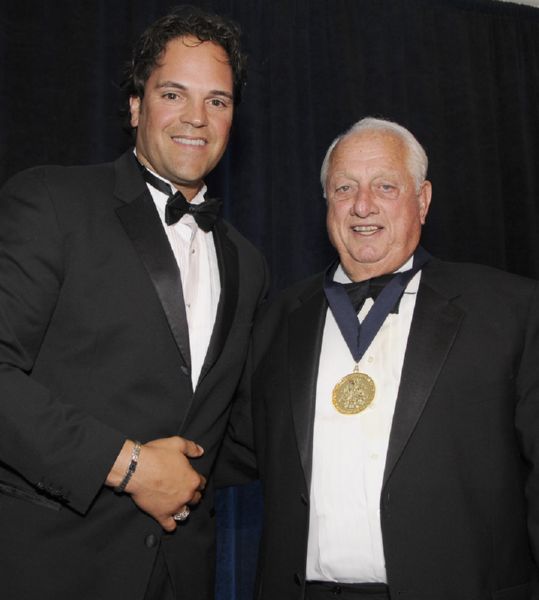
I wouldn’t have ‘Italia’ on the front if I didn’t have ‘Grilli’ on the back. Obviously, I love the United States. But I’m also proud of my lineage.”Tommy Lasorda was honored in 2011 by the National Italian American Foundation
when he was presented the NIAF Lifetime Achievement Award in Sports Management
by Team Italia Coach, 12-time MLB All-Star and former Dodger catcher Mike Piazza. “You know, they say the more you hang around Italians, the more Italian you become,”
said Grilli. “And that’s what I am. I’m an Italian,” said the Italian right-hander (il Italiano adopera la mano destra) who reminisced about his experience playing for Team Italia in
the World Baseball Classic. “One day Tommy Lasorda came in to talk to us. It was one of
the greatest speeches I’d ever heard. I wish I’d memorized or recorded it. He talked about the pride that comes with being Italian, with such feeling. It was a great experience.”
Having been invited to attend the 28th Annual Italian Coach Convention in Parma, Italy, Grilli is seriously considering a coaching career in Italy after he retires from Major League Baseball. “I know (former MLB All-Star and Team Italia coach) Mike Piazza has a house
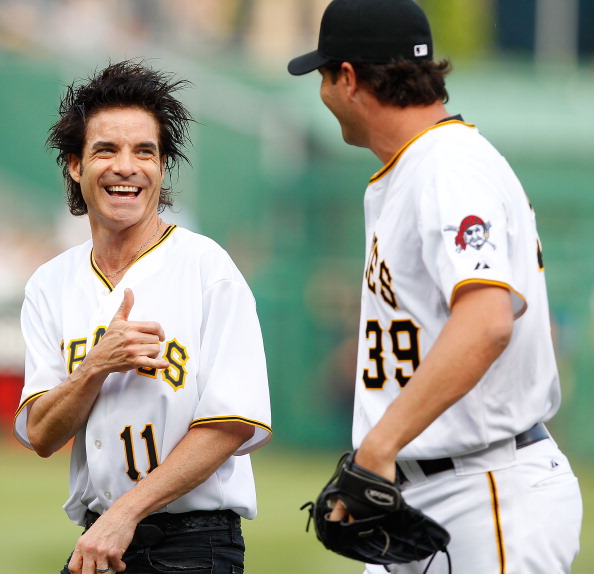
(in Italy), and he goes over for a couple months every year,” Grilli said. “It‘s intriguing.”Grilli and Team Italia stand at attention during the playing of the Italian National Anthem before being eliminated by Venezuela in the 2009 World Baseball Classic at Rogers Centre.Team Italia Major Leaguers Jason Grilli, Alex Liddi and Francisco Cervelli celebrate after Grill held host Canada scoreless for three innings and picked up the save at the 2009 World Baseball Classic in Toronto.Selected by the San Francisco Giants in the first round of the 1997 First-Year Player Draft (fourth pick overall), Grilli made his MLB debut with the Florida Marlins in 2000 and has made 330 career appearances during his 10 seasons in the big leagues. The Pirates signed Grilli as a free agent on July 21, 2011, and he has posted a 2.76 ERA with 127 strikeouts in 92 appearances over the last two seasons. He hinted at comfort and a heightened sense of excitement for Pittsburgh’s resurgence to Clemente-era dominance as top reasons for re-signing. “I’ve been on 10 different teams,” Grilli said. “The grass is never always greener. It’s really all the same. There’s just something fitting here. It’s just a baseball town and it bugs me as much as it bugs everybody else in this city. They want this so bad.” In 2012 Grilli limited opponents to just one run in 15 of his 64 appearances and struck out at least one hitter in 56 of the 64 games. He set a franchise record for relievers by striking out at least one batter in each of his first 19 appearances in 2012. Although a bull in the pen on the mound, Jason is quite the gentlemen to members of the press. The local chapter of the Baseball Writers Association of America recently voted Grilli as the winner of the Chuck Tanner Award–an award that recognizes the player who is most cooperative with the media.Train lead singer Patrick Monahan shares a laugh with Pittsburgh Pirates’ closer Jason Grilli.Roberto Clemente statue at PNC Park in Pittsburgh. Jason Grilli wants to bring back the World Series glory days to Pittsburgh. As a proud Italian, he supports MLB’s initiative to foster baseball’s popularity in Italy through the Federazione Italiana Baseball Softball (FIBS)-sponsored MLB Italian Academy and international games like the World Baseball Classic. Grilli said, “I’m in the books in Italian baseball, and that’s good. Major League Baseball wants the game to grow globally, and I’m happy to be a part of that.”
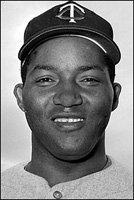
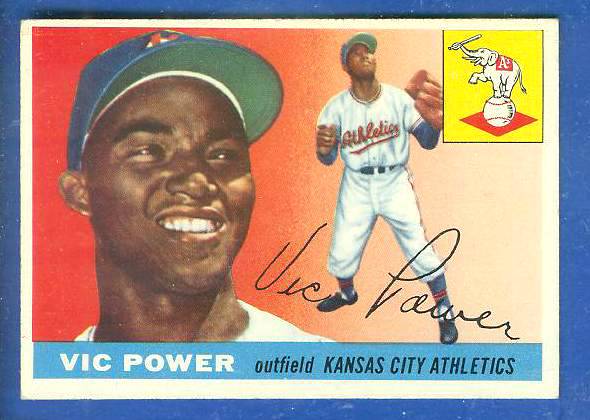
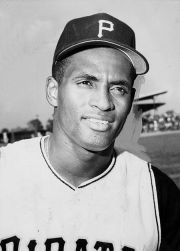
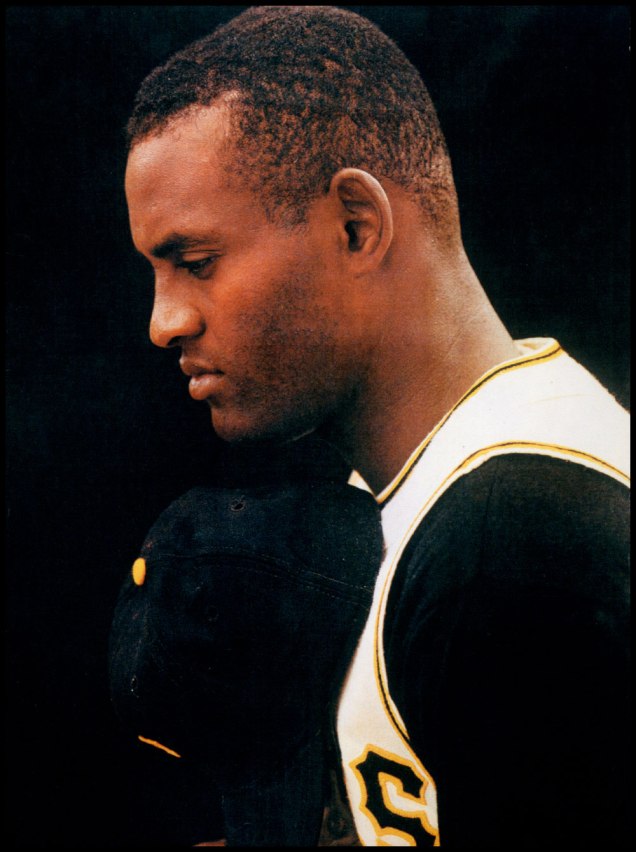
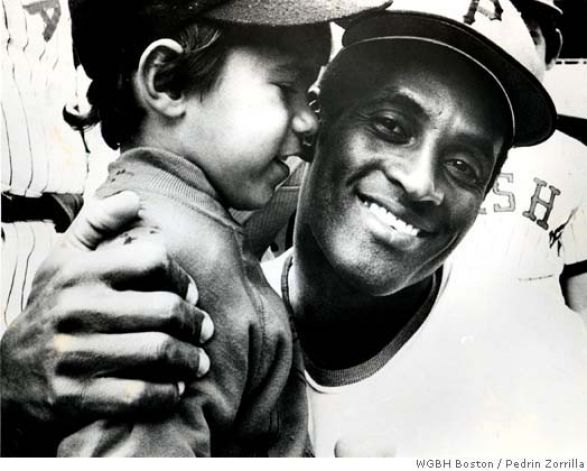
Victor “Vic Power” Pellot was the 1962 Twins MVP.The Great One “El Magnifico” Roberto Clemente was both black and Latino, one who sought equality despite the disparity between Puerto Rico’s easygoing acceptance of all and America’s hardline segregation regarding race, language and culture during the 50’s. The first black Puerto Rican to play in the American League was Clemente’s friend “El Gran Senor” Vic Power, the flashy-fielding Kansas City Athletics outfielder–who was dragged off the team bus one spring by the local authorities for buying a Coke from a whites-only gas station. Roberto despised the humiliation, internalizing it as if it were his own. Power tried to calm Clemente down with his wit and humor by recalling a conversation he had with a server at a Jim Crow-esque restaurant. “We don’t serve Negroes,” said the waitress. Power was relieved and replied, “That’s okay. I don’t eat Negroes. I just want rice and beans.”“El Magnifico” Roberto Clemente was elected posthumously into the MLB Hall of Fame in 1973.As a Spanish-speaking black man from Puerto Rico, Clemente battled against discrimination from day one
in America and was outspoken about the inequities
he faced. During his first seven years at Pirates Spring Training in Florida, he was not afforded the comfortable amenities a downtown hotel offered. Instead, Clemente was confined to living with a black family in the Dunbar Heights section of Fort Myers. When the Pirates held its annual spring golf tournament at the local country club, Roberto and the other black teammates were excluded.
As if that was not enough disrespect, while his white teammates dined at roadside restaurants on Grapefruit League road trips, Clemente would have to remain on
the team bus. Fed up with such atrocities, he finally coerced the Pittsburgh Pirates front office management
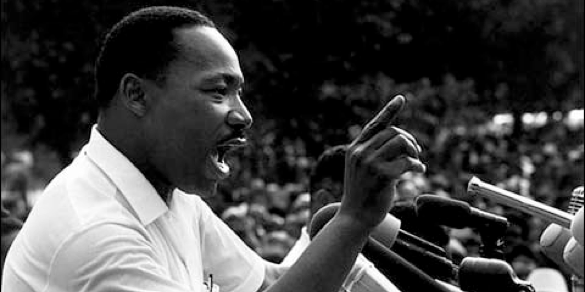
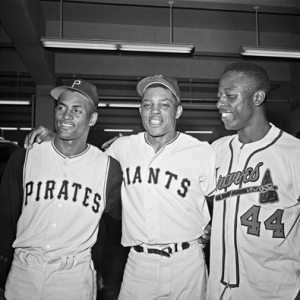
to allow the black players to travel in their own station wagon. Clemente said that enduring the unjust racial divide during spring training was like being in prison.Dr. Martin Luther King, Jr. spoke at Universidad Interamericana de Puerto Rico in February 1962.1961 National League All-Stars Roberto Clemente, Willie Mays and Hank Aaron celebrate their victory
after Clemente was named Most Valuable Player. Roberto Clemente’s admiration for
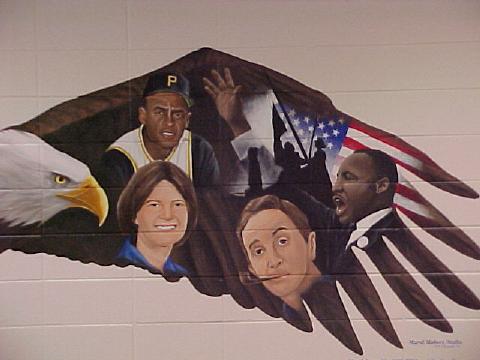
Dr. Martin Luther King, Jr. and his participation in the civil rights movement was spurred by the racism he experienced in the United States. During his professional career from 1954 to 1972, he saw significant change in both Major League Baseball and American society. Clemente was an intelligent and politically-charged activist who marched in the street protests of the 60’s and spent time with the Reverend Martin Luther King, Jr. when the civil rights leader visited him at his farm in Puerto Rico. He
had a strong connection to King as
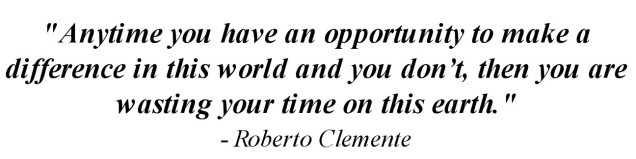
the humanitarian witnessed firsthand the black freedom struggle from the Montgomery Bus Boycotts to the urban ghetto rebellions and from Rosa Parks to the Black Panthers. When Dr. Martin Luther King, Jr. was assassinated in Memphis on April 4, 1968, Pittsburgh Pirates All-Star Roberto Clemente was devastated by the news. However, out of respect for the slain leader, he gathered up his teammates for a meeting to prevent the Pirates and Astros from opening their season on April 8th–the day before King’s burial. He convinced his fellow Pirates, which included 11 African-Americans, to stand with him in unity. As a result of his extraordinary call to action in honoring his fallen hero, Pirates 1968 Opening Day was postponed and moved back to April 10th in observance of King’s memorial service. Like Dr. King, Clemente was a passionate believer of social and economic justice. Clemente once said, “If you have the chance to make things better for people coming behind you and you don’t, you are wasting your time on earth.”
David Maraniss quotes Clemente about being warned before speaking out on American injustice in his 2005 biography of the Hall of Fame outfielder: “They say, ‘Roberto, you better keep your mouth shut because they will ship you back.’ [But] this is something
from the first day I said to myself: I am in the minority group. I am from the poor people.
I represent the poor people. I represent the common people of America. So I am going
to be treated like a human being. I don’t want to be treated like a Puerto Rican, or a black, or nothing like that. I want to be treated like any person.” Clemente had a profound social conscience and drive for justice. Toward the end of his career, Clemente felt he had made some headway against prejudice. “My greatest satisfaction comes from helping to erase
the old opinion about Latin Americans and blacks,” he said.On April 3, 1968 Dr. Martin Luther King, Jr. gave a speech saying, “I would like to live a
long life. Longevity has its place. But I’m not concerned about that now. I just want to do God’s will. And He’s allowed me to go up to the mountain. And I’ve looked over. And I’ve seen the promised land. I may not get there with you. But I want you to know tonight,
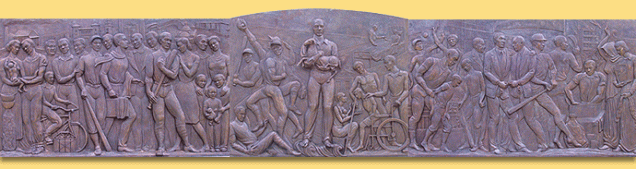
that we as a people will get to the promised land.” Clemente shared Dr. King’s personal fatalism and always believed that he would die before his time. His widow Vera remembered, “He always said he would die young that this was his fate.” Born on August 18, 1934 in Puerto Rico just outside of Carolina’s sugar cane fields–where today nearby stands a 30-foot-long cenotaph which encapsulates the life and death of the Puerto Rican legendary hero–Roberto Clemente boarded an ill-fated overweight DC-7 aircraft attempting to fly from San Juan to earthquake-stricken Nicaragua with relief supplies and died when the humanitarian mission flight went plunging into the sea shortly after take off on New Year’s Eve, 1972. Roberto Clemente is regarded with the reverence of a saint, a perspective reflected by the 30-foot-long cenotaph in Carolina, Puerto Rico. The center panel portrays Clemente holding a lamb.Clemente’s body was never found so the cenotaph designed by José Buscaglia is a heartfelt tribute to the Puerto Rican hero. Traditionally, cenotaphs are funerary monuments dedicated to heroes whose bodies are not recovered from the field of battle. So the very genre of Buscaglia’s work honors Clemente as one who gave all for his country. In the center panel, the lamb in Roberto’s arms is the lamb from the Puerto Rican coat of arms. In his life and death, Roberto lifted Puerto Rican identity to a new level in the world. The monument’s inscription reads “Son of Carolina, Exemplary Citizen, Athlete, Philanthropist, Teacher, Hero of the Americas and the World. Believing the promised land was more than a vision, both Clemente and King sacrificed everything to help set into motion a righteous path toward peace, equality and justice for oppressed people throughout the world. On the door of the room Clemente used during Pirates Spring Training is a plaque that reads Roberto’s final wish: “I want to be remembered as a ballplayer who gave all he had to give.” Indeed, not only would that quote suffice as an appropriate epitaph but also accurately depicted the consummate good samaritan that Clemente was in being of service to all.

 While America’s exports to Australia amounts to over $27.5 billion, baseball is a priceless Aussie favorite. No matter how many machines, engines, pumps, vehicles, aircraft, spacecraft, gems, precious metals, coins, pharmaceuticals, plastics, rubber and chemical goods make their way Down Under, these were some of the Top 40 American imports (#11-20) in the thriving


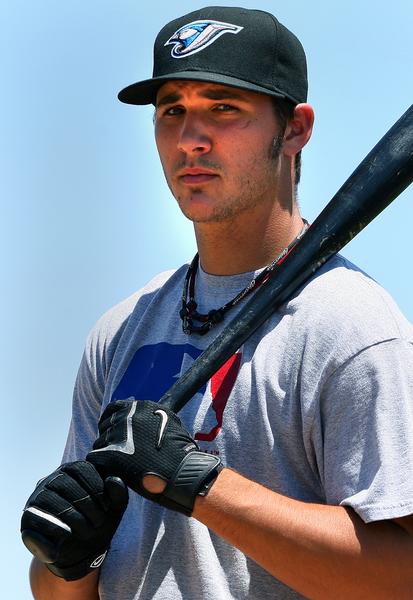

 #16 Jim Schult of the Brisbane Bandits was named the 2011 Division III National Player of the Year while playing at Eastern Connecticut State University. A First Team All-American Collegiate Pitcher, Schult joined the Can-Am NYSL Federals in 2011 and the Frontier League’s Joliet Slammers in 2012. With unlimited potential and a bright baseball future ahead, the 23-year-old New Yorker made a great debut pitching in the ABL with a superb 4-2 record and will be welcome back.